
Dutch Health Council Report into Transgender Care for Youth: A Methodological Appraisal
Suggested citation
Society for Evidence-Based Gender Medicine. Dutch Health Council Report into Transgender Care for Youth: A Methodological Appraisal: Interim report. November 28, 2026. segm.org/dutch-health-council-gender-report-analysis
Introduction
On June 30, 2026, the Health Council of the Netherlands issued its advisory report on transgender care for young people (hereafter Health Council Report, or Report). (1) The subject of the Report is the practice of pediatric gender reassignment, which originated in the Netherlands in the 1990s and has come to be known as the “Dutch Protocol.” Recently, evidence reviews by several European public health authorities found the practice to have an unfavorable risk-benefit ratio and restricted the practice of pediatric gender transitions. In response to practice reversals of the Dutch Protocol in countries such as Sweden, Finland, and the UK, the Dutch Parliament asked its own government to conduct a scientific assessment of the practice, and to determine whether the practice is lawful under Dutch health law.
The task was assigned to the Dutch Health Council (2)—a statutory body that advises the government and parliament on the broad field of public health based on “the state of the science.” (3) Following a two-year review, the Dutch Health Council issued its Report concluding that the scientific evidence supports the benefits of medical gender reassignment of minors, and that the practice falls within the framework of Dutch health law. Key to the Council’s conclusions was the assertion that transgender care for young people in the Netherlands “is characterized by a carefully structured process.” (4) Although the Council acknowledged that “the strength of the scientific evidence is low,” it determined that the uncertainties “do not prompt the committee to recommend changes to the current care approach.” (5)
The conclusions of the Dutch Health Council departed markedly from the findings of recent reviews in Finland and Sweden and, perhaps most notably, from the UK Cass Review (6). The Cass Review was an “independent review”—a process deployed in the UK whenever an area of medicine begins to operate in a way that risks threatening care quality or undermining patient safety (7). By design, independent reviews are led by highly respected members of society with no direct connection to the practice under review, to eliminate the possibility of conflicts of interest and to provide a truly independent assessment.
The Cass Review was conducted over a four-year period and was underpinned by research from the University of York, including several systematic evidence reviews, concluding that the field of pediatric gender medicine is operating on an unacceptably poor evidence base (8). The Cass Review noted several concerning facts about pediatric gender medicine, including a rapid increase in referrals; mental health vulnerabilities among youth presenting for care; a marked change in presentation of gender dysphoria and the associated diagnostic and prognostic uncertainties; as well as the lack of demonstrated health benefits, and the risk of serious harms associated with the Dutch Protocol interventions, some of which are irreversible, and others of which have unknown long-term effects.
These concerns prompted a total restructuring of the UK’s approach to gender-dysphoric minors. Breaking with the Dutch Protocol, the new UK approach delays hormonal and surgical interventions until adulthood and prioritizes psychosocial interventions in adolescence (9). Similar changes in practice occurred in Finland, Sweden, Denmark, and a number of other countries and jurisdictions internationally, following their own reviews of the current state of pediatric gender medicine (10). That the Dutch Health Council’s conclusions diverge so strikingly from those arrived at by several other countries that completed their own independent analyses is noteworthy and deserves a careful analysis. The purpose of this report is to provide this needed scrutiny.
It is important to acknowledge that the care for gender-dysphoric young people has been hotly debated, with strong and sharply divergent opinions about how to best help this vulnerable population of youth—including political debates both in the Netherlands and internationally. Political involvement in medical questions is often viewed with suspicion, and sometimes rightly so. In other instances, political debate gives voice to a legitimate public concern—reflecting a healthy democracy at work. The motions that the Dutch Parliament passed regarding the examination of the Dutch Protocol gave the Netherlands the opportunity to examine its own practice on its own terms.
The Dutch Health Council, which was tasked with the work, acknowledges that in order for its recommendations to be trusted by Dutch society, it must operate with “independence and transparency” and adhere to “the highest scientific standards.” (11) Recently, the Chair of the Health Council, Karien Stronks, agreed that public debate about the practice must proceed from accurate facts (12). We hope that our report will help Dutch stakeholders assess the accuracy of the Health Council Report’s scientific claims in order to determine the extent to which the Council met its obligation to inform the government about the state of the science. We make no recommendations about how Dutch society should resolve the ongoing debate about the practice of pediatric transgender medicine; our only concern is that the facts on which that debate is based are accurate.
The relevance of our analysis, however, extends beyond the Netherlands. The Dutch Health Council’s conclusions will have a significant international impact because the Netherlands is widely viewed as the world’s intellectual headquarters for youth transgender medicine. Dutch clinicians pioneered the Dutch Protocol, published the foundational studies on which the field rests, and continue to produce research that anchors the field. These Dutch clinician-pioneers have also been key in promulgating pediatric transgender medicine internationally (13) and, in response to the recent wave of restrictions on the practice, have strongly advocated against such restrictions worldwide (14). Given the central role of the Netherlands in the development of the field and ongoing global debate, the Health Council Report’s conclusions and the process by which they were reached are a matter of international interest.
Our approach
The Health Council’s Report addressed two fundamental questions asked by Dutch parliamentarians—whether the treatments are scientifically justified, and whether they are lawful. However, a subsequent reframing by the Minister for Medical Care made the scientific inquiry central, subjugating the legal analysis to the Council’s scientific findings. Correspondingly, we focus our analysis primarily on the validity of the Council’s scientific conclusions.
We assessed the Health Council’s Report from two perspectives. First, we examined the integrity of the process through which the Report was produced: whether it was independent, and whether it was adequately safeguarded against conflicts of interest. In assessing the process, we referenced standards and procedures the Council is expected to follow (15). Second, we analyzed the content of the Council’s Report itself, assessing the quality of its scientific output, applying widely accepted standards in evidence-based medicine. Specifically, we completed a formal ROBIS (16) assessment to judge the trustworthiness of the Health Council’s evidence review.
The primary source of information for our analysis is the Health Council Report itself and its accompanying support documents (17). In addition, we examined the Health Council’s internal records concerning the Health Council and its work producing the Report, which were released under the Dutch Open Government Act [Wet open overheid (Woo)] (18).
In the course of our analysis, we discovered that the parliamentary questions that had formed the premise of the Health Council’s Report were substantively changed by the Minister, significantly narrowing the nature of the original requests. As a result, the Report that the Health Council produced leaves unanswered several important questions contained in the parliamentary motions. The gap is significant enough to deserve separate analysis, which we provide.
Because of the sheer volume and complexity of the documents produced by the Health Council, and the breadth and depth of the analysis they require, we are releasing this as an interim report, with a more comprehensive final report to follow in the coming weeks. We have made every effort to verify each fact and have provided extensive footnotes with both the original Dutch text and English translations. It is nonetheless possible that this interim report contains inaccuracies. We therefore welcome close engagement with its contents and will make all necessary corrections before the final release.
Terminology
Regarding the condition being treated, we use “gender dysphoria,” “gender incongruence,” and “gender distress” interchangeably. The clinical definitions of these terms differ (the first two are distinct diagnoses with different criteria, while the third is a descriptor of a feeling that may be attributable to either of the first two diagnoses, a different diagnosis, or no diagnosis at all). However, in the clinical literature, including in the studies assessed in this review, there has been a considerable blurring of the lines between all three, with the Dutch Protocol interventions delivered in all of the contexts above.
With regard to the treatment in question, we use the “Dutch Protocol” synonymously with the approach of treating pediatric gender dysphoria or gender incongruence with endocrine and surgical (“somatic”) interventions that alter a minor’s physical appearance so as to obscure their sex or make them appear as members of the opposite sex. Although some details have changed since the first publication about the Dutch Protocol 20 years ago (19), the Protocol’s hallmark—the use of medical interventions in adolescence with the intention of altering the body’s natural development—has remained unchanged since its inception.
For the specific endocrine interventions that comprise the Dutch Protocol, we use “puberty blockers” and “puberty suppression” interchangeably to refer to the first stage of the Dutch Protocol, and “cross-sex hormones” to refer to the second stage—the administration of testosterone to females and estrogen to males. We use these terms as neutral descriptors of what the drugs do. The term “gender-affirming,” which is a non-neutral descriptor, appears in this document only when quoting the Health Council Report or other sources.
Regarding the patient population, we use “adolescents” to refer to those who have entered puberty—the patients to whom the Dutch Protocol’s interventions are delivered—and “minors” for anyone under 18. We use “young people” and “youth” more broadly to encompass children, adolescents, and young adults—a population distinctly different from mature adults who have completed adolescent development. We avoid “transgender adolescents” or “transgender youth,” because a transgender identity is not a clinical diagnosis and is not a predictably stable trait in those who have not yet completed their development. The term “transgender” appears only in references to the field or when quoting the Health Council Report or other sources.
Background
a. The Dutch Health Council Report is a result of two parliamentary requests
The Health Council Report came about as a result of two motions by the Dutch House of Representatives in early 2024 (20). The Dutch parliamentarians referenced a marked rise in the number of minors with gender dysphoria seeking gender transition, and an ongoing international medical-scientific debate over the lack of evidence that gender-affirming treatments for minors are safe and effective. Noting that several European countries, including Sweden, had become more cautious about medical gender transition of minors under the so-called “Dutch protocol,” the parliamentarians asked whether the Netherlands, the protocol’s birthplace, might face the same problems as those reported in other countries.
The two motions asked for scrutiny of the Dutch approach to gender transition of minors from the scientific and legal perspectives.
- Scientific perspective. The parliamentarians asked for a study of the physical and mental health outcomes of Dutch youth and a comparison with outcomes in other European countries where youth were being treated under a different approach.
- Legal analysis. The question posed was whether the practice of gender reassignment of youth is consistent with the Dutch health law framework.
The two motions were not an isolated initiative but the culmination of growing concern about pediatric gender transition that began in the Netherlands in the late 1990s. As part of the societal debate, a member of the Dutch Parliament asked the Minister of Health, Welfare, and Sport whether the practice was ethically acceptable. The Minister defended the treatments as a “responsible medical practice,” referencing a 1998 Health Care Inspectorate report which had found that the treatment “follows carefully designed, fixed, multidisciplinarily determined procedures laid down in protocols” for adults and adolescents alike (21).
The professional debate did not abate following the Minister’s reassurance. In the early 2000s, new concerns were raised regarding the high rate of psychiatric illness in individuals who seek to undergo gender reassignment, raising renewed questions about the wisdom of gender reassignment in the midst of adolescent development (22). The pioneers of the Dutch Protocol dismissed those concerns as invalid (23). Ultimately, public attention in the Netherlands died down—in part through the Dutch research team’s publications on the protocol, which discussed the risks of both the treatment and nontreatment, and through the launch of the foundational research which would provide the official scientific justification for the practice (24).
The Dutch debate reignited in 2022–2023, following growing international concern about the practice of pediatric transition and new reviews of the practice in Finland, Sweden, and the UK, which found it problematic and led to sharp restrictions for minors (25). Dutch ethicists, experts in evidence appraisal, and legal scholars once again began to challenge the practice in the country’s leading medical and law journals (26). The country’s public broadcaster’s two-part documentary (27)—“The Transgender Protocol”—had put the same questions before a national audience. In parallel, the government commissioned research into the causes of the sharp rise in demand for transgender care (28). The results of the research were published in 2023, with the researchers reporting that they were unable to establish the causes of the increased referrals to the gender clinics (29). In 2024, the official evaluation of the Dutch 2018 treatment guideline found that it fell short of the Dutch Healthcare Institute’s criteria for a quality standard (30).
It was against the backdrop of these Dutch developments and several key international decisions to stop following the Dutch Protocol that the Dutch Parliament adopted two motions in early 2024, to investigate the scientific and legal foundations of the Dutch Protocol, ultimately giving rise to the Dutch Health Council’s 2026 Report.
b. The Minister substantively altered the content of the parliamentary request
Following the adoption of the two parliamentary motions regarding the scientific and legal analyses of the Dutch Protocol, the Minister for Medical Care issued a letter to the Health Council (31). The letter served as the terms of reference for the Report, explaining what was expected of the Health Council, and what framework should be applied when making recommendations.
Problematically, the Minister’s letter substantively altered Parliament’s original questions, lowering the bar for the required scientific and legal analysis.
For the legal analysis, the Minister modified the original parliamentary request to assess the fit between the current practice of youth gender transition and the Dutch health law framework, into the much narrower question of whether the published 2018 Dutch guideline itself fits within Dutch health law. This is a fundamentally different question, as it is possible for a guideline to be lawful—yet for the practice to be unlawful if it deviates from the guideline in an important way that is at odds with Dutch health laws.
For the scientific analysis, the Minister replaced an explicit request for research into treatment outcomes with a much vaguer request to “contribute to insight”—a change that ultimately left the Health Council free to sidestep any formal research into mental and physical health outcomes of the youth treated according to the Dutch Protocol.
The Minister’s letter to the Health Council also included additional premises not contained in the parliamentary motions—including the Minister’s assertion of the medical necessity of medical interventions for gender-dysphoric minors, as well as the suggestion that, like the government itself, the Council should defer to the expertise of stakeholders in the field of gender medicine and not question their practice (32)—thus contravening the very premise of an independent appraisal of the Dutch Protocol. The Minister’s prior positions in support of the practice of pediatric gender reassignment provide important context (33), suggesting that the manner in which the Council was instructed to conduct its inquiry was shaped by the Minister’s own intellectual biases from the start.
Table 1: Minister’s reframing of the original Parliamentary motions (34)
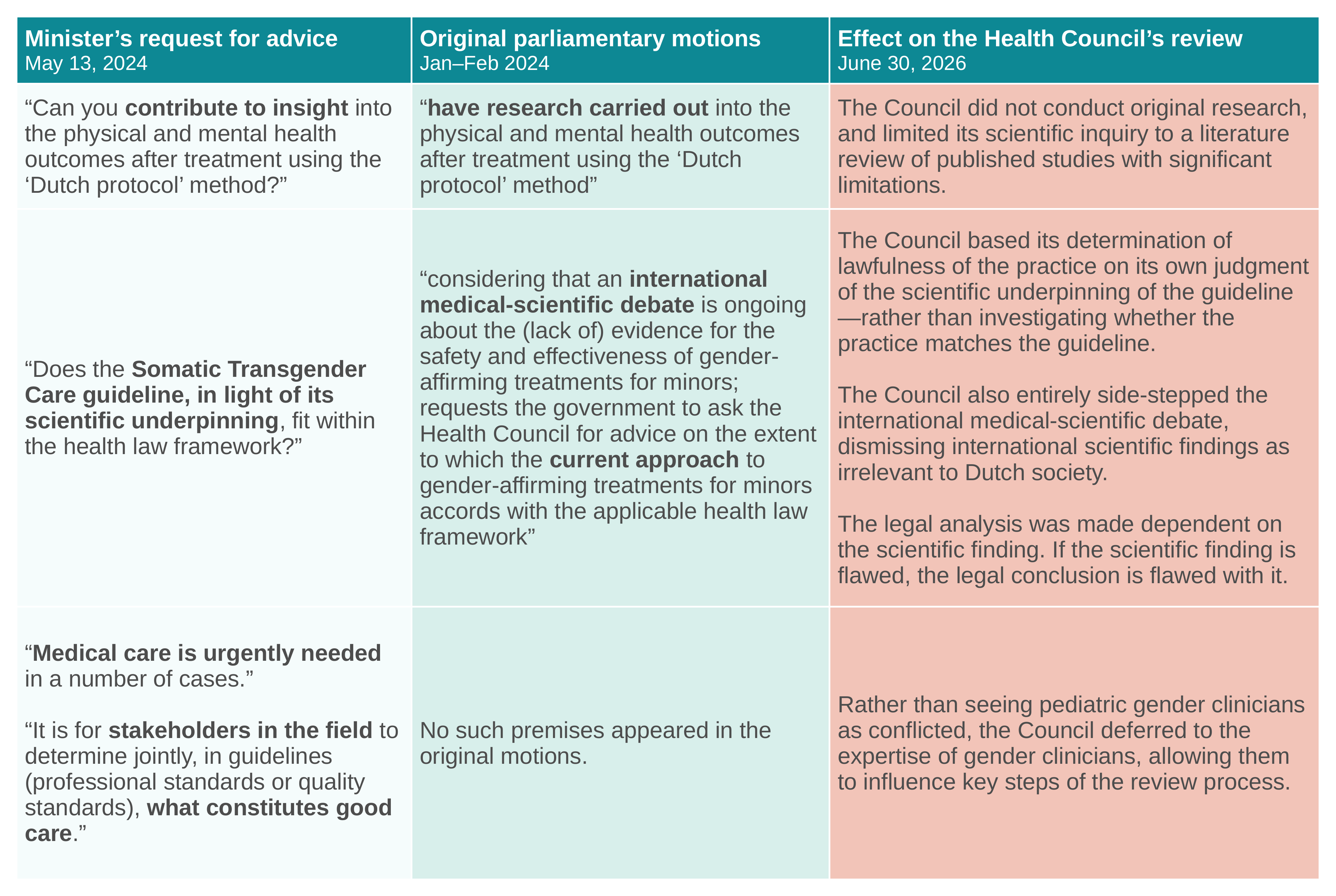
Furthermore, the Minister’s choice to combine the two different motions into a single request for advice, and to direct both to the Health Council, further limited the scientific analysis that could be produced, since the Health Council does not conduct original research (35). The poor fit between the fundamental questions about the practice of pediatric gender reassignment raised by Parliament and the much more limited typical remit of the Dutch Health Council has been noted by a Dutch legal scholar (36).
Analysis of the Health Council’s Process
a. Each key step of the Dutch Health Council’s process was compromised by conflicts of interest and other process irregularities
The Health Council’s work was part of a larger process and was itself conducted in several stages, as illustrated below. Significant conflicts of interest and procedural irregularities permeated every stage of that process: from the moment the Minister altered the requests contained in the parliamentary motions and passed them on to the Health Council; through the Council’s scientific secretaries’ preparatory work, which was guided by those with a vested interest in the review’s outcome; to the formation of a temporary committee overwhelmingly biased in favor of the Dutch Protocol; and, finally, to the Council leadership’s endorsement—and the Minister’s acceptance—of the final Report.
The remainder of this section elaborates on the most notable process irregularities at each stage, with a focus on the parts of the process that were within the control of the Health Council itself. These same conflicts are graphically represented in a chart at the end of this section.
b. The Dutch Health Council’s internal operations were opaque and influenced by unmanaged conflicts of interest
While the temporary committee recruited by the Council is responsible for the final content of a Health Council Report, the Health Council’s own role in shaping the final Report cannot be overstated. It is the Health Council that is tasked with identifying the approach needed to fulfill the Minister’s request, conducting the literature review, selecting and approving the temporary committee participants, managing conflicts of interest, preparing discussion papers and drafting advisory reports for the committee, and approving the final result (37).
Many of these decisions take place during the preparatory stage, several months before the temporary committee itself has its first meeting. The Health Council’s workings during the crucial preparatory phase are largely opaque, but documents released under Woo reveal substantial influence by individuals with serious conflicts of interest—including key staff from Dutch gender clinics (38).
For example, while identifying the relevant literature, the Health Council’s secretaries took their lead from a gender clinician who guided the Council toward the evidence supporting the Dutch approach and away from evidence that may have raised concerns about this approach—including proactively casting doubt on the validity of the Cass Review and the research into a possible role of social influence on the development of gender distress in adolescents (39). The same documents show that the Council strongly favored individuals who are actively engaged in providing transgender interventions, and turned away several otherwise qualified professionals on the grounds that they were not involved in delivering transgender interventions.
Arguably, the Health Council leadership was following the Minister’s direction to defer to the expertise of the gender clinicians (and other stakeholders) when determining what constitutes “good care.” (40) However, given the context in which the request for a review arose—a parliamentary inquiry into whether the Dutch Protocol is scientifically sound and lawful—the Council’s leadership should have recognized that centering the opinions of the very clinicians who pioneered or strongly support the Dutch Protocol is inconsistent with the premise of an independent review of the Dutch Protocol. It is possible that the leadership’s own institutional and scholarly ties to the institutions and individuals supporting the Dutch Protocol precluded such a realization, preventing it from recognizing the problems in the process it created and endorsed (41).
c. The temporary committee the Council appointed had significant unmanaged conflicts of interest
The Health Council was responsible for identifying and approving the individuals who serve on its temporary committee responsible for the final content of the Report. This aspect of the Health Council’s work is bound by the Rules of Procedure and its Code for the Prevention of Improper Influence Due to Conflicts of Interest (42) as well as by the guidelines spelled out in the Information Brochure for Committees (43).
According to these rules and regulations, conflicts of interest should be managed according to a “principle of proportionality,” with participation ranging from “full participation” to “full exclusion” depending on the gravity and relevance of the interest. Financial conflicts of interest disqualify an expert from nearly all participation, while nonfinancial conflicts—such as protecting one’s own reputation or position—must be managed proportionately (44). The process also requires balance in intellectual views and positions held by those participating in the process, which should be achieved by “including different disciplines, viewpoints, and schools of thought.” (45)
Contravening these rules, six of the committee’s 12 participants were allowed to sit on the committee despite having a clear and significant level of conflict of interest. Another four committee participants had conflicts of interest that are of concern, and only one participant had no identifiable conflict. Notably, while most of the committee participants ranged from holding strongly to moderately supportive views of the Dutch Protocol, not a single participant was on record as opposing the Dutch Protocol.
The following examples are not an exhaustive list, but serve to highlight the breadth and depth of conflicts of interest within the committee:
- 2 committee participants owned or co-owned private gender practices and hold clinical positions at them: a potential financial and reputational COI.
- 4 committee members have strong ties with pediatric gender clinics, creating potentially significant reputational COIs: 2 committee participants worked as clinicians at pediatric gender clinics; a 3rd committee member had done so in the past, and remained employed at the university medical center, retaining a reputational stake; a 4th physician worked as a researcher at a pediatric gender clinic.
- 3 other committee participants worked at a university medical center that housed pediatric gender clinics, a potential reputational COI.
- 9 committee participants have a published record supporting the Dutch Protocol, with 6 of them having a substantial enough record to constitute a significant potential intellectual and reputational COI.
- 6 had pre-existing publication relationships with one or more members of the committee through co-publications in support of the Dutch Protocol.
- At least 18 of the publications assessed and included in the Report and its supporting documents were written by 7 committee participants.
The conflicts of two participants were managed by appointing them as “structurally consulted experts” without voting rights. However, both were present for nearly all committee meetings (ten and nine of the ten, respectively), including meetings devoted to substantive discussion and revision of the draft report (46). As has been noted by a Dutch legal scholar, it is unclear what role the voting itself played in the final Report, and to what extent having no vote—while substantively participating in the deliberations—was a meaningful safeguard against such serious conflicts (47).
The presence within a committee of even one member with a strong prior commitment to the outcome of a review can influence the questions that are asked and how critically the evidence is examined. When more than half the committee is in that position, and no opposing voices are present, the challenges become insurmountable. To allow the committee to include such a high number of conflicted participants is unprecedented: a published review of five years of advisory requests found nothing remotely comparable in scale (48).
d. The “periodically consulted experts” were highly conflicted
Concerningly, the clinicians from Amsterdam UMC, one of whom pioneered the Dutch Protocol and both of whom serve as its strongest proponents in the Netherlands and internationally were officially appointed as “periodically consulted experts” to the review, and tasked with presenting the “criticism and concerns” about the Dutch Protocol to the committee (49). At least one of these experts was providing advice to the secretaries six months before the committee’s first meeting (50).
Appointing clinicians who either pioneered the practice under review or who lead and promote it as advisors to the inquiry into the practice introduces one of the strongest possible conflicts of interest. Given the context for the inquiry—parliamentary motions asking whether the Dutch Protocol is a scientifically justified and lawful practice, against the backdrop of several countries having restricted or halted it—it is unclear why the Council failed to see this obvious conflict of interest.
e. Consultations with international experts were unbalanced
A key component of the Council’s work was an international review, which was explicitly requested by the parliamentary motions. However, the consultations with international experts had a demonstrable bias.
The committee heard from six foreign experts, four of whom support the Dutch Protocol interventions as the primary response to pediatric gender dysphoria, and two of whom are concerned about the practice, producing a clear imbalance. Paradoxically, Sweden—which restricted the use of puberty blockers and cross-sex hormones to exceptional cases per its 2022 policy (51)—was represented by a pediatric gender clinician who is a strong proponent of the Dutch Protocol interventions and has questioned the evidentiary concerns underpinning the country’s own more restrictive policy (52). Other Nordic countries that sharply restricted the use of endocrine interventions for gender-dysphoric minors—Finland, Norway, and Denmark—were not represented at all.
Furthermore, while the participation of each of the two critics of the Dutch Protocol was offset by inviting a proponent of the Protocol from the same country (Germany and the UK, respectively), the reverse was not applied to the proponents: the Protocol’s supporters from France and Sweden were left unopposed.
f. Stakeholder consultations were unbalanced
The committee’s stakeholder consultation also shows evidence of a lack of balance. The committee heard from five young people and/or their parents who advocated for a more liberal/less restrictive approach to the provision of hormones, and from two transgender advocacy organizations (Transvisie and Transgender Netwerk Nederland). In contrast, the committee heard from only one concerned citizen and only one organization advocating for a more restrictive approach (Stichting Voorzij). (53) Notably, all the invited organizations that advocated in favor of the Dutch Protocol had pre-existing connections with the committee participants and the “periodically consulted” experts. No connection was found between the committee and the one organization with an opposing view (54).
Concerningly, although the Minister’s request explicitly asked the Council to assess regret, no detransitioners presented their experiences to the committee, despite several publicly known cases. Apparently, none of the Dutch detransitioners met the Council’s required profile (55).
Conclusion
With at least half of the committee participants highly conflicted, the process demonstrably contravened the Council’s code for managing conflicts of interest (56). Further, the broader participation—including the invited Dutch and international experts as well as stakeholder groups—was overwhelmingly skewed toward those with a position of support for the Dutch Protocol, falling short of the Council’s requirement “to bring opposing views to the table by including different disciplines, viewpoints, and schools of thought on the committee.” (57) The chart below illustrates the conflicts and the lack of balance.
In effect, the Dutch Health Council gathered together the proponents of pediatric gender medicine and asked them to grade their own homework—the antithesis of an independent appraisal.
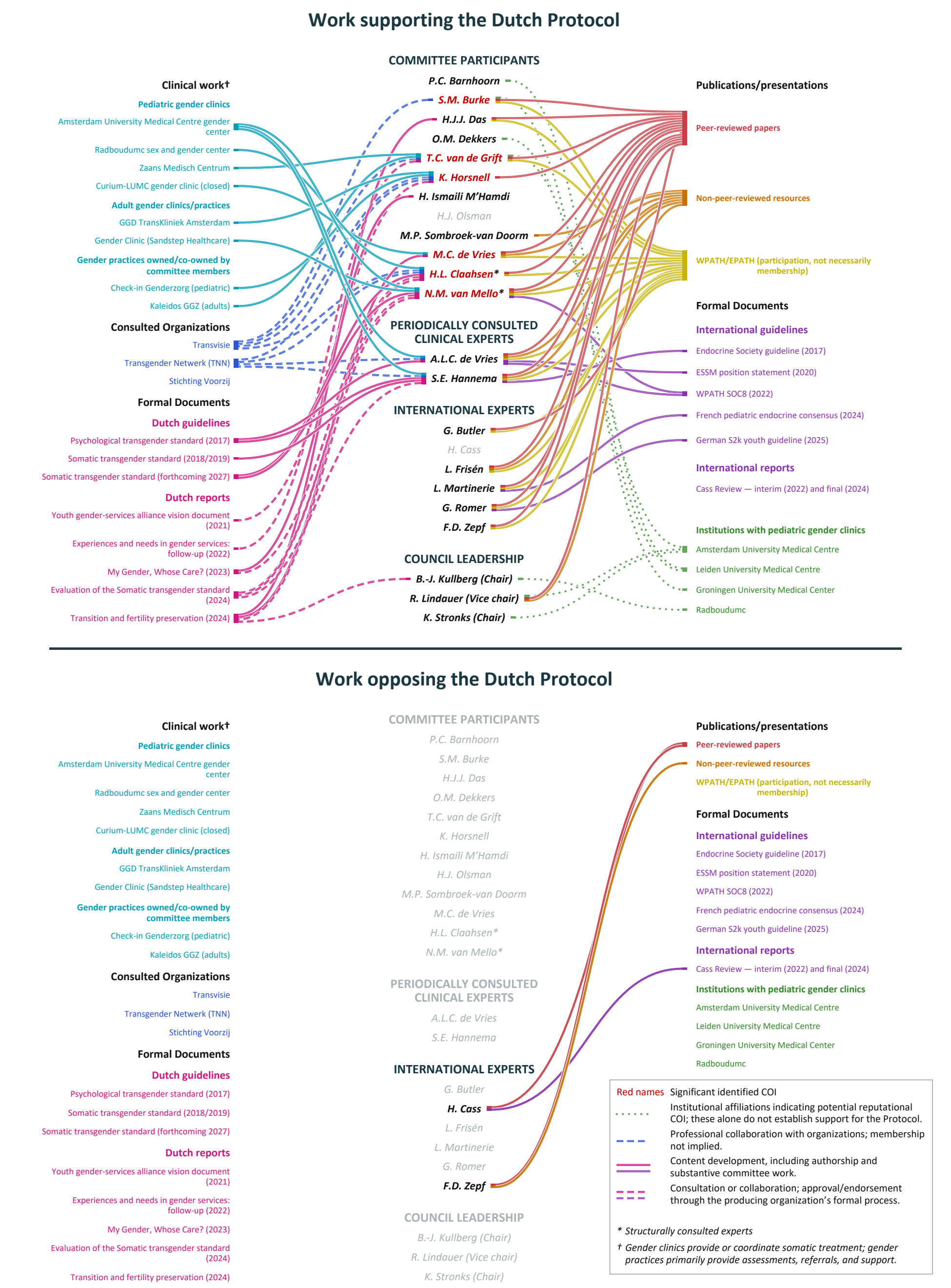
Analysis of the Health Council’s Scientific Output
a. The evidence review did not meet the required methodological standard
The Health Council’s rules require that the analyses it produces meet high standards of scientific rigor (58). According to evidence-based medicine, and under the Dutch health system’s own standards, systematic reviews constitute the most trustworthy method of appraising clinical evidence (59). The Council deviated from this critical principle of evidence-based medicine and failed to conduct such a review. Instead, the Council undertook a literature review that contained elements of a “systematic search”—a far lower bar, and one the Council did not meet in practice. Literature reviews are not reproducible and involve picking and choosing which aspects of results to highlight, putting them at a high risk of bias.
It is unclear how the Council identified the relevant literature and assessed its quality, although documents released under the Open Government Act indicate that Dutch gender clinicians steered the process toward the subset of literature reporting positive outcomes (60).
While the history of the review process remains opaque, its results are clearly problematic. The Council omitted relevant studies, in particular those reporting negative results; appraised other studies inappropriately, consistently imposing positive interpretations on mixed or negative findings; and made a number of other errors of fact and interpretation, which invariably favored the practice under review. When assessed with ROBIS, the standard instrument for judging the risk of bias in evidence reviews (61), the Council’s review receives the lowest possible rating: “high risk of bias.” In methodological terms, this means that the review’s conclusions may diverge substantially from the evidence base in question, and, consequently, that the Report is not a trustworthy basis for evidence-based decision-making.
| ROBIS | Study Eligibility Criteria | Identification and Selection of Studies | Data Collection and Study Appraisal | Synthesis and Findings | Overall RoB |
| Dutch Health Council Report | High | High | High | High | High |
b. The decision to exclude international literature was not justifiable
The Dutch Health Council decided to exclude international literature from its assessment of the mental health benefits of pediatric gender transition. Its justification was that mental health outcomes “are partly dependent on the national healthcare model and political and societal factors,” so that results from other countries “are therefore not readily generalizable to the Dutch situation.” (62)
The decision to exclude international literature appears to have been made relatively late in the review process. The documents released under the Open Government Act indicate that the committee first decided to exclude the UK research as not applicable, and later extended the same decision to all international research regarding mental health outcomes (63). Notably, the UK was the first country to attempt to replicate the foundational Dutch research, using the same eligibility criteria and the same outcome measures, but failed to reproduce the positive results reported by the Dutch researchers (64). Finland, which remains the only country to have followed the long-term outcomes of every adolescent referred to gender services using comprehensive national registers, has also failed to replicate the positive outcomes reported by the Dutch studies (65). Other international studies, including those from the United States, likewise failed to reproduce the Dutch findings (66).
Ordinarily, multi-center research plays a key role in corroborating a single center’s findings. When other centers cannot reproduce the original result, the divergence both reduces confidence in that result and warrants investigation of its causes (67). Instead of paying careful attention to the differences in the reported outcomes, the Council merely excluded the divergent literature, justifying this with the assertion that the marked difference in the outcomes reported by different countries is primarily due to the unique nature of the Dutch healthcare system and a more accepting society.
This rationale is difficult to accept, since the countries whose research the Council’s Report omitted—such as Finland, Sweden, and the UK—have similar well-functioning centralized healthcare systems and are among the most liberal societies in the world, with some extending legal protections to transgender individuals even before the Netherlands did so.
The Council’s decision to exclude international literature also goes against the historical trend of international collaboration in transgender medicine (e.g., the European Network for the Investigation of Gender Incongruence [ENIGI], with significant Dutch leadership) and the more recent statement from the Amsterdam UMC that it is coordinating a multicenter European follow-up study of puberty suppression (68).
Furthermore, the decision to isolate the Dutch pediatric gender medical practice from the rest of the world contradicts the precedent set by the very experts who served on or advised the Health Council committee itself. In 2018, a study co-authored by a member of the Dutch Health Council’s committee and two consulted experts noted that nearly all centers follow the same standards, and treated all international pediatric gender centers as a single comparable field (69). More recently, in 2024, a Cass-commissioned survey of pediatric gender medicine practices in Europe also observed general comparability between the various countries’ approaches, despite some variability in practice. Notably, the practices reported by several Dutch clinics were at times less cautious than those reported by some other countries (70).
Finally, the exclusion of international literature is also at odds with the Council’s own assignment. The Council was explicitly asked for a comparison of Dutch outcomes with those reported by other countries (71). A valid comparison of outcomes requires engaging with the international literature. No such comparison can be made when that literature has been excluded.
c. The conclusion of absence of harms is not trustworthy
The Dutch Health Council concluded that puberty blockers and cross-sex hormones are “not associated with serious side effects or complications” (72) and that the current data on unintended physical health effects are “not cause for concern.” (73) The Council’s conclusion on the absence of harms rests on five errors.
First, the Council did not consider mechanistic evidence from basic biology and pharmacology. For example, all youth treated according to the Dutch Protocol as intended (i.e., puberty blockers at Tanner stage 2 of puberty and proceeding directly to cross-sex hormones) will be infertile, with no established method of fertility preservation. Dutch research shows that many adolescents treated with puberty suppression later came to want biological children, indicating that fertility is a patient-important outcome (74). Several other harms, including those to bone health during the pubertal-suppression phase, and adverse cardiovascular effects of cross-sex hormones are also expected based on well-established mechanistic evidence. Such harms are widely acknowledged by gender clinics and are listed on consent forms.
Second, the Council compounded the error of understating risks by excluding the morbidity and mortality literature pertaining to adult gender transition. A markedly reduced lifespan and increased all-cause morbidity and mortality have been reported throughout the adult transgender literature in the Netherlands (75) as well as internationally (76), with consistently documented elevated cardiovascular, metabolic, urogenital, and malignancy risks in people treated with cross-sex hormones over the long term.
The Report itself conceded that most youth will remain on cross-sex hormones for life, which makes adult outcomes directly relevant to adolescent care. Excluding the adult literature on the harms of cross-sex hormones and then reporting “no concern” about harms based on adolescent studies is akin to judging the safety of adolescent smoking by the absence of demonstrable lung disease among the population of adolescents who smoke.
Third, the Council did not adequately engage with the evidence of harm apparent in the very studies it did assess. For example, the Council acknowledged that puberty blockers reduce bone density and that recovery in natal males is often incomplete, but then attributed the deficit to lifestyle rather than treatment (77). In summarizing a cardiovascular study of young adults treated since adolescence, the Council referenced the significantly reduced elasticity of the aorta but omitted the study authors’ own description of this outcome as an early marker of vascular aging and a predictor of stroke and coronary artery disease (78). Likewise, the Council noted that erythrocytosis (an abnormally high concentration of red blood cells) occurs “relatively frequently” in adolescent females on testosterone, but omitted the study authors’ warning that, according to current guidelines, these elevated levels carry a moderately high risk of cardiovascular or cerebrovascular events (79).
Regarding sexual function, the Council made no mention of the high rate of sexual dysfunction among those treated with the Dutch Protocol. Yet the very studies the Council relied on show that 67% of sexually active natal males regularly experienced sexual difficulties after vaginoplasty, including difficulty reaching orgasm, pain, and shame about their genitals (80), and that half or more (58% of natal females and 50% of natal males) reported at least one distressing sexual problem (81). Instead, the Council focused on rates of sexual satisfaction, claiming sexual satisfaction was comparable to that of the general population. However, even the “comparable sexual satisfaction” came from comparing the Dutch Protocol patients with an average age of 29 (82) to studies evaluating international populations with a substantially older average age (83). The Netherlands’ own national sexual health survey indicates that young adults rate their sex lives higher than any other age group, so age alone makes those international comparisons with much older groups invalid (84).
Fourth, the Council wrongly equated the dearth of high-quality clinical research on the harms of Dutch Protocol treatments with the proven absence of such harms. This is due in part to the fact that the treatments were deployed as standard practice with no prior research into the safety of the Protocol, and in part because the original Dutch research downplayed the significance of the harms that already were apparent early on. The foundational 2014 study focused exclusively on psychological outcomes, mentioning only in passing that one young person died as a direct result of treatment and that several youth were found to have uncontrolled diabetes or morbid obesity by the end of the treatment (85). Due to the study design (e.g., a lack of a control group), these physical harms are as attributable to the treatment as the reported psychological benefits.
The field of pediatric gender medicine urgently needs to focus on a high-quality, comprehensive evaluation of the long-term physical health effects associated with the endocrine interventions comprising the Dutch Protocol. In the meantime, the absence of robust, population-based clinical evidence of harm should not be confused with evidence of the absence of such harms, especially given the presence of compelling mechanistic evidence.
Fifth, the Council excluded surgery and surgical harms from consideration entirely, despite the fact that mastectomy is regularly offered in the Netherlands as part of the Dutch Protocol to patients as young as age 16. Further, hormonal effects and subsequent surgery are not entirely independent variables. Research suggests that adolescent females taking testosterone may be more likely to pursue mastectomy due to rising discordance between their masculinized appearance and the presence of breasts (86). In males, pubertal suppression arrests genital tissue development, leaving insufficient genital tissue for vaginoplasty, which necessitates the use of bowel tissue instead—leading to a more complex and riskier surgery. The risks are illustrated by the reported death of an 18-year-old Dutch patient who died from post-surgical infection following such a procedure (87). These examples—combined with the widely recognized high rate of complications in genital surgeries (88)—demonstrate why surgical outcomes cannot be carved out from the consideration of the Dutch Protocol.
d. The assertion of benefits to mental health is not supported by the evidence
The Dutch Health Council’s decision to support pediatric gender transition rests in large part on its finding that there are “indications of some improvement” (89) in mental health outcomes for youth treated according to the Dutch Protocol. As discussed above, this conclusion was reached by examining only the Dutch research, while excluding findings from international research that contradicts it. However, even when evaluating the Dutch research alone, the Council failed to examine the trustworthiness of the conclusions, a step mandated by systematic review methodology. Instead of adopting an evidence-based medicine approach to evidence synthesis and appraisal, the Council appears simply to have accepted the primary studies’ conclusions at face value. Notably, every one of these studies was co-authored by A.L.C. de Vries (90), the Amsterdam UMC clinician who is a foundational figure of the Dutch Protocol and who was consulted by the Council throughout the entire review process (91).
In asserting mental health benefits of cross-sex hormones, the Council cited only a single Dutch study (92). Notably, however, that study only evaluated mental health outcomes after surgery, so the independent effects of cross-sex hormones cannot be assessed. Systematic evidence reviews have recognized this problem and have consequently excluded this study due to its inability to supply evidence regarding the effects of cross-sex hormones on mental health (93).
In asserting mental health benefits of puberty blockers, the Council referenced a total of three studies (94). All three studies (two of which reported on the same group of youth) suffer from serious methodological limitations, including attempting to compare groups that are not comparable, reporting as significant changes that were too small to be clinically meaningful, or even providing a misleading representation of the study methodology in ways that make the results appear more robust than the study supports.
For example, the seminal Dutch research on puberty blockers (95) reported that subjects were selected “prospectively,” which signals a more robust study design, since in prospective studies patients are identified before the treatment outcomes are known and followed through the end of the treatment. However, a close reading of the study reveals that subjects were selected retrospectively, only after the results of the puberty blocker treatment were already known to the researchers. Moreover, the subjects were selected not randomly but based on having obtained clinical approval to proceed from puberty blockers to cross-sex hormones. Such an approach favored the highest-functioning patients. Notably, the outcomes of the entire cohort treated with puberty blockers have never been reported, and other countries—including the UK (96) and the US (97)—have been unable to replicate the results of this seminal Dutch research.
More generally, numerous systematic evidence reviews (98) have rated the evidence for benefits of puberty blockers and cross-sex hormones as “very low certainty” under GRADE [Grading of Recommendations Assessment, Development and Evaluation] (99). In plain terms, this means that it is unknown whether endocrine treatments improve mental health, worsen it, or have no effect.
Regrettably, the Council reiterated the erroneous claim that the reason for the “low” and “very low” certainty ratings in pediatric gender medicine is the absence of randomized controlled trials (RCTs), asserting that because RCTs are challenging in this population, “the level of evidence will necessarily be rated as (very) low.” (100) This is inaccurate on three counts. First, the UK has launched a formal clinical trial of puberty blockers, demonstrating that the obstacles to controlled research can be overcome (101). Second, the assertion suggests that the Council is unaware that large scale, high-quality prospective observational studies can, under GRADE, yield moderate or sometimes even high quality evidence (102).
Third, and most importantly, the Council’s explanation of why the evidence in this field consistently receives a (very) low rating is misleading. The evidence of pediatric gender medicine is rated as low/very low quality because the studies, including the foundational Dutch research, rely on small samples, do not follow the subjects over the long term, lose a significant number of study subjects to follow up, and suffer from significant confounding, making it impossible to determine whether the medical intervention, the psychological support, or the mere passage of time led to often small and inconsistent improvements in mental health. These limitations have been widely acknowledged by all quality systematic reviews (103), and can be overcome by commissioning a high-quality prospective study with proper comparators, or by conducting retrospective comparative registry research similar to the research Finland has done (104).
e. The assessment of regret rates was inadequate
The Council’s reassurance that “the number of cases of regret is low” (105) rests on two Dutch studies (106), neither of which adequately measured regret. The first study reported short-term outcomes, assessed on average about 1.5 years after surgery (vaginoplasty for natal males, mastectomy and hysterectomy with ovariectomy for natal females), when the mean age of participants was 20.7 years. The study did not formally evaluate regret yet stated that “none regretted treatment.” (107) As noted above, one participant died from surgical complications resulting from the Dutch Protocol treatment, and at least one dropped out of care, possibly having detransitioned—experiences that could be classified in the category of “regret.” Two further participants refused to take part and two did not return their questionnaires, raising questions about whether a refusal to engage with the very clinical team that cared for them, so soon after the final surgery, may mask a form of regret.
The second study counted regret only among patients who had completed the full medical course through removal of the ovaries or testes and who subsequently returned to the clinic to request hormones of their natal sex (108). However, most of today’s patients are young females who do not undergo removal of the ovaries, but who do experience irreversible masculinization of their appearance and voice, and loss of breasts. The referenced study is incapable of measuring regret in such cases.
A case in point is the Dutch detransitioner “Iris” (Jett) who is vocally regretful (109), but because she did not have her ovaries removed and has no need to request a prescription for female hormones, Jett’s regret would not be captured by the study. This illustrates how the study’s narrow definition limits the generalizability of its findings to today’s youth—while also indicating that even among the earlier-presenting cases, the narrow definition of “regret” used by the study likely underestimated the frequency of the phenomenon. The peer-reviewed literature has noted that regret is a complex phenomenon, and that estimates of its frequency depend heavily on how individual studies define and measure it (110).
The Health Council’s failure to interview any detransitioners during the stakeholder consultation illustrates that the Health Council’s assessment of regret following pediatric gender reassignment is inadequate. Rather than hearing from young people who regret the treatment—some of whom are publicly known, and others of whom could be identified through additional research—the Council heard only from patients who had wanted the treatment and were frustrated that their clinicians had started puberty blockers “too late” or been “too cautious.” (111) The Minister later assured Parliament that the committee had consulted young people and parents “with positive and negative experiences of transgender care,” without disclosing that the only negative experiences on record concerned delay or caution (112).
At best, such an assessment of treatment-associated regret is unbalanced; at worst, it suggests a lack of sensitivity to the needs of the highly vulnerable population of detransitioners.
The Council’s finding of low regret is also internally inconsistent. On consecutive pages, the Report both asserts that the scientific research “shows” regret is low and concedes that, because of “the generally short follow-up periods and substantial dropout rates in studies,” it is “not possible to accurately determine the number of people who regret their decision.” (113)
f. The conclusion that the Dutch practice is “careful” is not justified
Key to the Council’s conclusion that the practice of pediatric gender transition is scientifically and legally sound was its determination that the practice in the Netherlands “is characterized by a carefully structured process.” Given the weight the Council placed on this argument, it is remarkable that, by its own admission, the committee “did not evaluate the implementation of care in daily practice” and instead relied on “applicable guidelines.” Thus, the Council’s judgment of the careful nature of the practice merely assumed adherence to the current guidelines (the 2017 mental health and the 2018 somatic care guidelines, specifically). (114)
Adherence to the guidelines, however, cannot be assumed. For example, even though the 2018 somatic care guideline requires that an adolescent meet the diagnostic criteria for gender incongruence before initiating endocrine interventions, Amsterdam UMC’s own data show that gender-affirming medical treatments have been started in adolescents who had not yet received a diagnosis, “with the purpose of creating (head)space for further exploration in their diagnostic trajectory.” (115) Likewise, although the Report states that cross-sex hormones may be initiated in the Netherlands at age 15 or 16, a study the Report itself cites documents 14-year-olds in the Netherlands receiving testosterone (116). Even the foundational Dutch study itself—de Vries et al., 2014—reports cross-sex hormones being started as young as 13.9 years of age (117).
Further, a recent survey of pediatric gender medicine practices in Europe, which received responses from four Dutch gender clinics, reveals that not all Dutch clinics follow the same process: the responding clinics reported differing numbers and types of assessment sessions required, as well as different tools for assessing gender dysphoria—the target condition being treated by the Dutch Protocol (118). Concerningly, one of the clinics listed as its only tool for the assessment of gender dysphoria the cartoon diagram known as the “Gender Unicorn.” (119) Even though the cartoon is not a validated measure of gender dysphoria, Amsterdam UMC gender clinicians have endorsed its use in clinical settings, despite their own acknowledgment that “because the concepts relating to gender are constantly developing, the visualizations of them are also constantly developing.” (120) It is further unclear why none of the responding Dutch clinics reported using the Utrecht Gender Dysphoria Scales for the assessment of gender dysphoria—the scales which the Dutch gender clinician-researchers themselves developed and validated (121).
Notably, the same survey of pediatric gender services in Europe found that Dutch clinics reported a less selective approach to eligibility for gender reassignment than that of several other countries—especially when compared to Finland and Denmark. Specifically, the Dutch clinics indicated that gender transition is available to youth with non-binary identities and to those with late-onset gender dysphoria, whereas Denmark and Finland reported deferring medical treatment of non-binary adolescents and those with post-pubertal onset of gender dysphoria to adulthood.
Further, even if the clinics all adhered to the 2018 somatic guideline—on which the Council based its determination of lawfulness—this would still be an insufficient basis to determine whether the practice is either scientifically valid or lawful. This is because the 2018 somatic guideline itself was deemed inadequate by an independent Dutch evaluation (122), and is currently undergoing revision.
g. The conclusions do not account for the changed patient population
The population of adolescents presenting with gender dysphoria has changed since the publication of the foundational research upon which the Council relied. The Council itself acknowledged that the number of referrals for young people suffering from gender dysphoria has risen sharply, with an overrepresentation of females, youth with psychiatric comorbidities and neurodevelopmental conditions like autism and ADHD [attention-deficit/hyperactivity disorder], and those with post-pubertal onset of gender dysphoria and non-binary identities.
The foundational Dutch research the Council cites as evidence of mental health benefit explicitly excluded such cases: adolescents were eligible for the Dutch Protocol only if they had shown persistent gender dysphoria since childhood, had no serious comorbid psychiatric disorders, and had a clear cross-sex identity (123). Questions about the applicability of the foundational Dutch research to a changing patient population were one of the central reasons that led Finland, Sweden, and the United Kingdom to re-evaluate their approach and to stop routinely offering medical gender reassignment to such youth.
It is unclear why the Council, which judged international research inapplicable to the Dutch context, saw no difficulty in applying the early Dutch research to a very different patient population previously deemed ineligible for treatment.
h. The account of international developments is inaccurate
In describing the international status of pediatric gender medicine, the Health Council recognized changes to practice in only two countries, England and Sweden, overlooking Finland, Norway, Denmark, and a number of other countries and jurisdictions. None of the three omitted countries was invited to present to the committee, and the foreign experts who were heard received just 10 minutes each to share their perspectives. Paradoxically, in describing the changes in England and Sweden, the Council asserted that “the new structure of transgender care there now appears much more like the current Dutch approach.” (124) This is demonstrably inaccurate.
In the Netherlands, medical transition remains the primary clinical response to adolescent gender incongruence: roughly 80% of adolescents assessed at the Amsterdam clinic go on to endocrine treatment (125). Sweden, by contrast, concluded in 2022 that “the risks of puberty blockers and gender-affirming treatment are likely to outweigh the expected benefits” and restricted both interventions to “exceptional cases.” (126) The misrepresentation of the UK position is even more profound. Puberty blockers for the indication of gender dysphoria/gender incongruence are banned in the UK (127) outside the PATHWAYS clinical trial (128), and in 2024 NHS England also sharply restricted cross-sex hormones for under-18s (129), with a proposed NHS policy to disallow their use completely (130).
While the Council correctly observed that several other countries, including Germany, Austria, Switzerland, Poland, and France, have not enacted similar restrictions, it failed to mention that the “gender-affirming” guidelines in those countries face rising professional disagreement and have been challenged within mainstream medical bodies (131). The Council also failed to mention that the international guidelines it referenced are of similarly low quality to the Dutch 2018 guideline, which an independent Dutch evaluation found did not meet the applicable quality standards (132). Like the Dutch guideline, the international guidelines the Council referenced were developed without proper management of conflicts of interest, and without systematic reviews of the evidence that underlie the recommendations—a significant reason why they are now being professionally disputed.
Most striking is the complete absence of any mention of Finland in the Report. Finland, whose care model closely followed the Dutch Protocol, remains the only country to date to have followed the longer-term outcomes of every adolescent referred to its gender services (133). Finland was also the first to systematically evaluate the evidence of the practice and to sharply restrict its availability on the basis of the findings, classifying the practice as experimental (134). The marked turns toward caution in Norway (135) and Denmark (136), which have likewise moved away from endocrine interventions for minors, are also left unmentioned.
Therefore, the Council’s presentation of international practice as converging on the Dutch model as practiced in the Netherlands is a plain mischaracterization.
i. The Ethics analysis is based on flawed premises
The Health Council’s discussion of ethical considerations makes several assertions that are consistent with medical ethics, but it fails to apply those principles in the context of the evidence regarding the benefits and harms of pediatric gender medicine, sidestepping the central ethical challenges of pediatric gender reassignment.
First, the Council incorrectly asserted that withholding hormonal interventions for gender-incongruent youth results in harm. It made this claim while acknowledging the low quality of the research supporting the benefits of treatment, arguing that the “harm of not treating” must also be weighed and that “non-treatment is therefore not a neutral option.” (137) The Council is correct that, absent puberty blockade, puberty will progress, and so in a narrow sense the withholding of medical intervention is not a “neutral” option. But whether or not an action is “neutral” is not a central ethics consideration. The central consideration is the risk/benefit ratio of the intervention. Because providing puberty blockers and cross-sex hormones has not been shown to be beneficial, as multiple systematic reviews synthesizing 30 years of research have found, the claim that withholding them is harmful cannot be methodologically substantiated.
Second, in its discussion of consent, the Council focuses on the importance of shared decision-making, neglecting the fact that shared decision-making enters the clinical decision-making process only after clinicians have made a prior determination, based on the best available evidence, that the interventions are likely to do more good than harm. Gender-affirming hormonal treatments have never cleared this bar.
The Council correctly states that it is the clinician who “determines what is prudent and medically justified in the patient’s best interest,” while it is the patient or their surrogate who chooses “whether to accept that recommendation.” (138) The Council is also correct that shared decision-making, in which clinicians and patients weigh the pros and cons of the treatments offered (including no treatment) is essential to sound clinical practice (139). But the Council omits the step that must precede shared decision-making: the determination that the treatment’s benefits outweigh its risks, a step required by the principle of nonmaleficence. Treatments whose risks outweigh their benefits should not be offered at all, even when the patient desires them.
The Council appears to operate on the assumption that the risk/benefit ratio of pediatric transition is favorable and that the treatment can therefore be offered. This follows from the Council’s own evaluation of the evidence, which wrongly concluded that benefits have been sufficiently demonstrated and that “concerning” harms are absent. But because that evaluation was not conducted to an accepted methodological standard and because it reached conclusions that sharply diverge from several recent independent reassessments of the same evidence, the Council’s ethics discussion rests on an evidence appraisal that cannot bear its weight.
Third, the Council makes an unsupported claim that gender transition interventions enhance “autonomy”—defined broadly as the ability “to lead a self-determined life.” (140) The Council’s hypothesized mechanism of action is that the hormonal interventions act by “reducing distress, increasing body satisfaction, and improving overall and social functioning”—which, in turn, expands the ability to lead a self-determined life (141).
However, two of the three mental health outcomes the Council referenced—reduced distress and improved functioning—have not been shown to be improved in a clinically significant way according to nearly a dozen systematic reviews conducted to date (142). Thus, the claim of enhanced autonomy resulting from such improvements is unsupported by the evidence. Further, if treatment-associated harms outweigh the uncertain benefits (for example, a patient experiences a loss of fertility without a measurable reduction in distress or improvement in functioning), the treatment could be said to be detrimental to autonomy, by the Council’s own logic. The Council does not engage with this possibility.
As for the third outcome, improved “body satisfaction,” absent a measurable improvement in standard health outcomes, Dutch health law places a treatment that alters the body to the patient’s satisfaction in the cosmetic category (143). Cosmetic procedures are recognized as legitimate and, for many, highly satisfying medical acts performed by medical professionals. But unlike interventions that cure or prevent disease, a cosmetic procedure is, in and of itself, neither medically necessary nor reimbursable according to Dutch health laws (144). The Council should therefore be careful in using cosmetic outcome measures as a standalone medical or ethical justification for the treatments.
Conclusion
Some of the Health Council’s findings deserve credit. The Council acknowledged that the evidence base for pediatric gender transition is of low quality; that the number of people who regret treatment cannot be reliably established; that the population now presenting to gender clinics differs markedly from the one studied in the foundational Dutch research, limiting that research’s applicability; and that it is the clinician who must determine what is medically justified, while the patient’s autonomy is reflected in their freedom to choose among the offered options—rather than demand a treatment that may not be clinically justified.
Despite these important and accurate observations, the Council dismissed their significance, overriding them with numerous erroneous and misleading statements and conclusions about the practice. The Report also misrepresented the reason for the “very low” quality of the research, wrongly asserting that such a low rating is an inevitable consequence of the absence of randomized controlled trials, and that a higher-quality evidence base is therefore not attainable.
The decision to exclude international research on mental health outcomes, which largely contradicts the research published by the Dutch gender clinics, and the Report’s misrepresentations of international changes in practice, are particularly concerning.
When the international community adopted the Dutch approach to treating gender-distressed adolescents on the strength of a single clinic’s experience, there was a clear expectation that rigorous, methodologically sound follow-up research, accompanied by an impartial interpretation of results, would follow. When this did not occur, other countries stepped in to fill the gap. They reported both alarming epidemiological changes (a marked shift in the patient population toward adolescent females with late-presenting gender dysphoria and psychiatric comorbidities) and unfavorable treatment outcomes, findings the Dutch medical establishment was slow to acknowledge (145). Eventually, the Dutch clinicians acknowledged that their foundational research may not be applicable to the current population of youth (146). That this acknowledgment came late is not surprising: medical innovators and their supporting institutions are often among the last to recognize the problems in the work they pioneered (147).
However, the latest approach of simply dismissing the international results as not relevant to the Dutch population, while insisting that the Dutch model works well in the Netherlands, represents a step backward. Given that the international debate prompted the Health Council’s assignment, and that the parliamentary motions explicitly asked for a comparison to other countries, the dismissive attitude toward the international developments was remarkable: each foreign expert was given 10 minutes to present and five minutes for questions, with the option of submitting anything further on one side of an A4 piece of paper (148).
The Council thus never had a meaningful opportunity to question whether, rather than producing more positive outcomes than those reported internationally, the Dutch clinician-researchers tend to interpret their own results more positively than an independent analysis would support. Previously published peer-reviewed research supports this hypothesis (149), and our own analysis supplies evidence consistent with this explanation.
Conclusions
The Health Council’s Report overstated the benefits of pediatric gender transition, understated the harms, and drew conclusions about the careful nature of current clinical practice without carrying out an actual review of that practice. Serious problems at every step of the Dutch Health Council’s evidence review process compounded, resulting in a Report that reflects neither the current state of the underlying science nor current clinical practice. Because the Council’s legal and ethics analyses relied on the findings of its evidence review, the problems that undermined the review’s trustworthiness carried through to the rest of the Council’s work.
The problems in the scientific analysis appear to stem in part from a failure to adhere to a high methodological standard in the evidence review, and in part from procedural failures to manage conflicts of interest among those responsible for interpreting the evidence and drawing conclusions. The Council operated under significant conflicts of interest involving the Dutch gender medicine establishment, which was tantamount to letting gender clinics mark their own homework. The resulting Health Council analysis is deeply flawed methodologically.
The problems, however, began even before the Health Council received its assignment for a review of the Dutch Protocol. The Minister, who was tasked with giving effect to the parliamentary requests for the scientific and legal analyses of the Dutch Protocol, substantively changed their content, creating a serious gap between what the parliamentarians asked for—and what was ultimately delivered. These substantive changes—along with the Minister's decision to direct the request for a scientific analysis to the Health Council, rather than to a number of other Dutch bodies better positioned to conduct rigorous research (e.g., the National Health Care Institute [Zorginstituut Nederland], ZonMw, or the Knowledge Institute of the Federation of Medical Specialists [Kennisinstituut]) or to assess healthcare practice (e.g., the Health and Youth Care Inspectorate [Inspectie Gezondheidszorg en Jeugd])—significantly limited the power and usefulness of the final analysis.
The process that led to the production of the Health Council’s Report—and the heavy influence of conflicts of interest that were not recognized as conflicts but instead were viewed as essential expertise—makes obvious the Dutch institutional commitment to upholding the Dutch Protocol, and illustrates the challenges of conducting a truly independent review in the country that pioneered the Protocol and many of whose institutions continue to endorse it. At the same time, this challenge should not be insurmountable: evidence-based medicine provides guidance for how to conduct trustworthy evidence reviews, and the Netherlands has a highly functioning healthcare system capable of such work in all other areas of medicine.
Given the Netherlands’ central role in the field of youth gender medicine, the country’s healthcare leadership has a responsibility to examine the evidence and clinical practice comprehensively and systematically, drawing on the full international literature and looking into the outcomes of all Dutch youth treated, in order to produce results that Dutch society and the international community can trust. The health and future wellbeing of tens of thousands of vulnerable young people worldwide are at stake. These young people deserve care based on a rigorous and transparent evaluation of what is known about a treatment that has been promoted now for more than 30 years both in the Netherlands and internationally. The Dutch Health Council’s Report has not provided such an evaluation.
References
- Gezondheidsraad, Transgenderzorg voor jongeren [Transgender Care for Young People], Advies no. 2026/12 (Gezondheidsraad, 2026), https://www.gezondheidsraad.nl/documenten/2026/06/30/advies-transgenderzorg-voor-jongeren. Hereafter: Dutch Council Report, or, Report. ↩︎
- Gezondheidsraad, ‘Over ons [About us]’, Gezondheidsraad, accessed 25 November 2026, https://www.gezondheidsraad.nl/over-ons. ↩︎
- Art. 22 Gezondheidswet (effective July 5, 2025). https://wetten.overheid.nl/BWBR0002202/2025-07-05/#HoofdstukIII_Artikel22. “De Gezondheidsraad heeft tot taak Onze Ministers en de beide kamers der Staten-Generaal voor te lichten over de stand der wetenschap ten aanzien van vraagstukken op het gebied van de volksgezondheid en het gezondheids(zorg)onderzoek door middel van het uitbrengen van rapporten” [The Health Council is tasked with informing Our Ministers and both chambers of the States General about the current state of the science regarding issues in the field of public health and health (care) research by issuing reports]. ↩︎
- Dutch Council Report, p. 5. “De huidige transgenderzorg voor jongeren in Nederland wordt gekenmerkt door een zorgvuldig ingericht proces, met een uitgebreide verkennende en diagnostische fase, zorgvuldige indicatiestelling en begeleiding door multidisciplinaire teams. Dat biedt volgens de commissie de ruimte voor de informatievoorziening aan de jongere en de ouders en voor de reflectie die nodig is voor vrijwillige geïnformeerde toestemming en gezamenlijke oordeelsvorming en exploratie.” [Current transgender care for young people in the Netherlands is characterized by a carefully structured process, featuring an extensive exploratory and diagnostic phase, careful assessment of eligibility, and guidance by multidisciplinary teams. According to the committee, this provides the necessary space for informing the young person and their parents, as well as for the reflection required for voluntary informed consent, shared decision-making, and exploration.]” ↩︎
- Dutch Council Report, pp. 5, 20, 44. “De huidige transgenderzorg voor jongeren in Nederland wordt gekenmerkt door een zorgvuldig ingericht proces” [Current transgender care for young people in the Netherlands is characterized by a carefully structured process]; “Tegelijkertijd is de bewijskracht van het wetenschappelijk onderzoek laag” [At the same time, the strength of the scientific evidence is low]; “Deze onduidelijkheden vormen geen aanleiding voor de commissie om te adviseren de zorg anders in te richten. Zij maakt daarbij de afweging dat niets doen ook schadelijk kan zijn voor de mentale gezondheid” [These uncertainties do not prompt the committee to recommend changes to the current care approach. In making this assessment, the committee considers that inaction can also be harmful to mental health]. ↩︎
- Hilary Cass, Independent Review of Gender Identity Services for Children and Young People: Final Report (2024), https://webarchive.nationalarchives.gov.uk/ukgwa/20250310143933/https://cass.independent-review.uk/home/publications/final-report/. ↩︎
- C. Ronny Cheung et al., ‘Gender Medicine and the Cass Review: Why Medicine and the Law Make Poor Bedfellows’, Archives of Disease in Childhood 110, no. 4 (2025): 251–55, https://doi.org/10.1136/archdischild-2024-327994. ↩︎
- Archives of Disease in Childhood, ‘Gender Identity Service Series’, BMJ Journals, 9 April 2024, https://adc.bmj.com/pages/gender-identity-service-series. ↩︎
- NHS, ‘Gender Dysphoria and Incongruence’, Health information webpage, NHS, 14 May 2026, https://www.nhs.uk/conditions/gender-dysphoria-and-incongruence/; Department of Health and Social Care, NHSE Policy on Masculinising and Feminising Hormones, Written ministerial statement no. HLWS1395, House of Lords Written Ministerial Statements (UK Parliament, 2026), https://questions-statements.parliament.uk/written-statements/detail/2026-03-10/hlws1395; UK Department of Health and Social Care, ‘Ban on Puberty Blockers to Be Made Indefinite on Experts’ Advice.’, 11 December 2024, https://www.gov.uk/government/news/ban-on-puberty-blockers-to-be-made-indefinite-on-experts-advice. ↩︎
- COHERE Finland, Medical Treatment Methods for Dysphoria Associated with Variations in Gender Identity in Minors – Recommendation (Council for Choices in Health Care in Finland (COHERE Finland), 2020), https://palveluvalikoima.fi/documents/1237350/22895008/Summary_minors_en.pdf/aaf9a6e7-b970-9de9-165c-abedfae46f2e/Summary_minors_en.pdf; Socialstyrelsen [National Board of Health and Welfare of Sweden], Care of Children and Adolescents with Gender Dysphoria: Summary (2022), https://www.socialstyrelsen.se/globalassets/sharepoint-dokument/artikelkatalog/kunskapsstod/2023-1-8330.pdf; Mette Vinther Hansen et al., ‘Sundhedsfaglige tilbud til børn og unge med kønsubehag [ Healthcare services for children and adolescents with gender dysphoria]’, Ugeskrift for Laeger 185 (2023), https://ugeskriftet.dk/videnskab/sundhedsfaglige-tilbud-til-born-og-unge-med-konsubehag. ↩︎
- Gezondheidsraad, Informatiebrochure voor commissies [Information brochure for committees] (Den Haag, 2026), 4, 12, https://www.gezondheidsraad.nl/over-ons/werkwijze/werken-in-commissies/informatiebrochure-voor-commissies. “De wetenschappelijke kwaliteit van de adviezen is een van de kernwaarden van de Gezondheidsraad. De andere kernwaarden zijn: multidisciplinariteit, onafhankelijkheid, omgevingsbewustzijn, beleidsrelevantie en transparantie” [The scientific quality of its advice is one of the Health Council’s core values. The other core values are: multidisciplinarity, independence, environmental awareness, policy relevance, and transparency]; “Beleidsmakers, politici, beroepsorganisaties, patiëntenorganisaties, uitvoeringsorganisaties en de Nederlandse maatschappij in brede zin moeten erop kunnen vertrouwen dat de adviezen van de Gezondheidsraad voldoen aan de hoogste wetenschappelijke eisen” [Policymakers, politicians, professional organizations, patient organizations, implementing agencies, and Dutch society at large must be able to trust that the Health Council’s advisories meet the highest scientific standards]. ↩︎
- Karien Stronks, ‘Transgenderonderzoek Gezondheidsraad was zuiver en eerlijk [Health Council’s transgender research was sound and honest]’, Opinie: Lezersreacties, NRC, 23 November 2026, https://www.nrc.nl/nieuws/2026/11/23/transgenderonderzoek-gezondheidsraad-was-zuiver-en-eerlijk-a4941928. ↩︎
- Ruth Hall et al., ‘Gender Services for Children and Adolescents across the EU-15+ Countries: An Online Survey’, Original Research, Archives of Disease in Childhood, ahead of print, 1 November 2024, https://doi.org/10.1136/archdischild-2023-326348. ↩︎
- Amsterdam UMC, ‘Een reactie van Amsterdam UMC op de Cass review over transgenderzorg [A response from Amsterdam UMC to the Cass Review on transgender care]’, 18 April 2024, https://amsterdamumc.org/nl/vandaag/een-reactie-van-amsterdam-umc-op-de-cass-review-over-transgenderzorg. ↩︎
- Royal Netherlands Academy of Arts and Sciences et al., Code for the Prevention of Improper Influence Due to Conflicts of Interest (KNAW, 2017), https://storage.knaw.nl/2022-08/Code-for-the-prevention-of-improper-influence-due-to-conflicts-of-interest.pdf; Gezondheidsraad, Reglement van orde van de Gezondheidsraad [Rules of Procedure of the Health Council] (Gezondheidsraad, 2020), https://www.gezondheidsraad.nl/documenten/2020/06/23/reglement-van-orde-gezondheidsraad; Gezondheidsraad, Informatiebrochure voor commissies. ↩︎
- Penny Whiting et al., ‘ROBIS: A New Tool to Assess Risk of Bias in Systematic Reviews Was Developed’, Journal of Clinical Epidemiology 69 (January 2016): 225–34, https://doi.org/10.1016/j.jclinepi.2015.06.005. ↩︎
- The three main documents supporting the Report itself are: Gezondheidsraad, Fysieke en mentale uitkomsten: Achtergronddocument bij Transgenderzorg voor jongeren [Physical and mental outcomes], Achtergronddocument (Den Haag, 2026), https://www.gezondheidsraad.nl/documenten/2026/06/30/fysieke-en-mentale-uitkomsten; Gezondheidsraad, Stoppen, spijt en detransitie: Achtergronddocument bij Transgenderzorg voor jongeren [Stopping, regret and detransition], Achtergronddocument (Den Haag, 2026), https://www.gezondheidsraad.nl/documenten/2026/06/30/stoppen-spijt-en-detransitie; Gezondheidsraad, Juridisch kader transgenderzorg voor jongeren: Achtergronddocument bij Transgenderzorg voor jongeren [Legal framework for transgender care for young people], Achtergronddocument (Den Haag, 2026), https://www.gezondheidsraad.nl/documenten/2026/06/30/juridisch-kader-transgenderzorg-voor-jongeren. ↩︎
- The released internal records include: 1. Internal emails: Gezondheidsraad, Woo Disclosure on Transgender Care for Young People 2 [Dutch], Woo-besluit (2026), https://segm.org/sites/default/files/2026-11/woo1.pdf; Gezondheidsraad, Woo Disclosure on Transgender Care for Young People 2 [English], Woo-besluit (2026), https://segm.org/sites/default/files/2026-11/woo1english.pdf.; 2. Committee meeting records: Gezondheidsraad, Woo Committee Meeting Records, Transgenderzorg voor jongeren committee, meetings 1–10, Dutch originals and English machine translations (2025), https://segm.org/sites/default/files/2026-11/woo2Committee.pdf. And 3. Health Council Meeting Agenda: Gezondheidsraad, Woo Health Council Meeting Agenda (2026), https://segm.org/sites/default/files/2026-11/woo3.pdf. ↩︎
- Henriette A. Delemarre-van de Waal and Peggy T. Cohen-Kettenis, ‘Clinical Management of Gender Identity Disorder in Adolescents: A Protocol on Psychological and Paediatric Endocrinology Aspects’, European Journal of Endocrinology 155, no. suppl_1 (2006): S131–37, https://doi.org/10.1530/eje.1.02231; Annelou DeVries et al., Clinical Management of Gender Dysphoria in Adolescents, 9, nos 3–4 (2006): 95–110, https://doi.org/10.1300/J485v09n03_05. ↩︎
- Kamerstukken II 2023/24, 36410 XVI, nr. 89. https://zoek.officielebekendmakingen.nl/kst-36410-XVI-89.html; Kamerstukken II 2023/24, 31016, nr. 370. https://zoek.officielebekendmakingen.nl/kst-31016-370.html. ↩︎
- Aanhangsel Handelingen II 1998/99, nr. 801 (Vragen van het lid Kant (SP); antwoord van minister Borst-Eilers, ontvangen 18 februari 1999), https://zoek.officielebekendmakingen.nl/ah-tk-19981999-801.html. “Uit genoemde rapportage van de inspectie blijkt de specifieke vorm van zorg waar het bij de behandeling van transseksualiteit om gaat, langs zorgvuldig opgezette, vaste, multidisciplinair bepaalde en in protocollen vastgelegde procedures te verlopen. Dit oordeel van de inspectie betreft zowel de behandeling van meerderjarigen als de behandeling van minderjarigen. Ik ben dan ook van mening dat het hier om verantwoord medisch handelen gaat.” [The said report of the Inspectorate shows that the specific form of care involved in the treatment of transsexuality proceeds along carefully designed, fixed, multidisciplinarily determined procedures laid down in protocols. This judgment of the Inspectorate concerns both the treatment of adults and the treatment of minors. I am therefore of the opinion that this constitutes responsible medical practice.] ↩︎
- Joost à Campo et al., ‘Psychiatric Comorbidity of Gender Identity Disorders: A Survey Among Dutch Psychiatrists’, American Journal of Psychiatry 160, no. 7 (2003): 1332–36, https://doi.org/10.1176/appi.ajp.160.7.1332. ↩︎
- Elsbeth Vernout, ‘Gewoon rustig je werk doen is er niet bij: interview met Peggy Cohen-Kettenis [Just quietly doing your job is not an option: interview with Peggy Cohen-Kettenis]’, Het Continuüm, 25 February 2004, https://www.continuum.nl/_artikel/interview_met_peggy_cohen-kettenis. ↩︎
- Delemarre-van de Waal and Cohen-Kettenis, ‘Clinical Management of Gender Identity Disorder in Adolescents’; Peggy Cohen-Kettenis et al., ‘The Treatment of Adolescent Transsexuals: Changing Insights’, Journal of Sexual Medicine 5, no. 8 (2008): 1892–97, https://doi.org/10.1111/j.1743-6109.2008.00870.x; Annelou L. C. de Vries et al., ‘Puberty Suppression in Adolescents with Gender Identity Disorder: A Prospective Follow‐up Study’, Journal of Sexual Medicine 8, no. 8 (2011): 2276–83, https://doi.org/10.1111/j.1743-6109.2010.01943.x; Annelou L. C. de Vries et al., ‘Young Adult Psychological Outcome after Puberty Suppression and Gender Reassignment’, Pediatrics 134, no. 4 (2014): 696–704, https://doi.org/10.1542/peds.2013-2958. ↩︎
- Kamerstukken II 2022/23, 31016, nr. 352, https://zoek.officielebekendmakingen.nl/kst-31016-352.html. ↩︎
- Jilles Smids and Patrik Vankrunkelsven, ‘Onzekerheden rond de huidige genderzorg [Uncertainties around the current gender care]’, Nederlands tijdschrift voor geneeskunde (Netherlands) 167 (November 2023): D7941; Lodewijk Smeehuijzen et al., ‘Transgenderzorg aan kinderen. Juridische bedenkingen bij het Dutch Protocol (2018) [Transgender care for children. Legal concerns about the Dutch Protocol]’, Nederlands Juristenblad, no. 25 (July 2023): 2058–69; Society for Evidence-Based Gender Medicine, ‘The 2023 Dutch Debate Over Youth Transitions’, Spotlight, 19 November 2023, https://segm.org/Dutch-protocol-debate-Netherlands. ↩︎
- BNNVARA, ‘Het transgenderprotocol [The Transgender Protocol]’, Collection page, Zembla, accessed 4 November 2026, https://www.bnnvara.nl/zembla/tags/het-transgenderprotocol. ↩︎
- Kamerstukken II 2022/23, 31016, nr. 352 (Brief van de minister van Volksgezondheid, Welzijn en Sport E.J. Kuipers aan de Tweede Kamer, “Twee onderzoeksrapporten op gebied van transgenderzorg” [Two research reports in the field of transgender care], 9 mei 2023), https://zoek.officielebekendmakingen.nl/kst-31016-352.html. ↩︎
- E. Das et al., Mijn gender, wiens zorg? Onderzoek naar de toename in en veranderingen van de vraag naar transgenderzorg [My gender, whose concern? An investigation into the increase in, and changes to, the demand for transgender healthcare], Onderzoeksrapport (Radboud Universiteit, 2023), https://www.rijksoverheid.nl/documenten/2023/05/09/mijn-gender-wiens-zorg-onderzoeksrapport. ↩︎
- Nederlands Internisten Vereniging et al., Kwaliteitsstandaard Transgenderzorg: Somatisch [Quality Standard for Transgender Care: Somatic] (Ministerie van Volksgezondheid, Welzijn en Sport, 2018), https://richtlijnendatabase.nl/uploaded/docs/Kwaliteitsstandaard_Transgenderzorg_Somatisch.pdf?u=0. Bijlage bij Kamerstukken II 2023/24, 31016, nr. 371 (evaluatierapport), bijlage 11, https://zoek.officielebekendmakingen.nl/blg-1136798.pdf. ↩︎
- Pia Dijkstra, Adviesaanvraag minister voor Medische Zorg over transgenderzorg [Request for advice from the Minister for Medical Care on transgender care], Adviesaanvraag nos 3808755-1064640-CZ (Ministerie van Volksgezondheid, Welzijn en Sport, 2024), https://www.gezondheidsraad.nl/documenten/2024/05/13/adviesaanvraag-vws-over-transgenderzorg. ↩︎
- Dijkstra, Adviesaanvraag minister.: “de overheid zich niet inhoudelijk bemoeit met de manier waarop zorgverleners goede zorg beschrijven” [the government does not interfere substantively with how healthcare providers define “good care”], leaving that definition to “veldpartijen” [stakeholders in the field]. ↩︎
- Pia Dijkstra, ‘Opinie: De seksuele vrijheid staat onder druk in Nederland [Opinion: Sexual freedom is under pressure in the Netherlands]’, Columns & Opinie, de Volkskrant, 18 June 2024, https://www.volkskrant.nl/columns-opinie/opinie-de-seksuele-vrijheid-staat-onder-druk-in-nederland~b8014865/. “Onze transgenderzorg is zorgvuldig, multidisciplinair en kent heldere richtlijnen.” [Our transgender care is careful, multidisciplinary and has clear guidelines] ↩︎
- Sources for Table 1. Motion Hertzberger (outcomes research): Kamerstukken II 2023/24, 31016, nr. 370 (motie van het lid Hertzberger, February 15, 2024), https://zoek.officielebekendmakingen.nl/kst-31016-370.html: “verzoekt de regering om onderzoek te laten doen naar de fysieke en mentale gezondheidsuitkomsten na behandeling met de «Dutch protocol»-methodiek en deze te vergelijken met cohorten patiënten in andere Europese landen, met een andere zorgstandaard” [requests the government to have research carried out into the physical and mental health outcomes after treatment using the “Dutch protocol” method and to compare these with cohorts of patients in other European countries with a different standard of care]. Motion Van Dijk (legal review): Kamerstukken II 2023/24, 36410-XVI, nr. 89 (motie van het lid Van Dijk, January 25, 2024), https://zoek.officielebekendmakingen.nl/kst-36410-XVI-89.html: “overwegende dat er een internationaal medisch-wetenschappelijk debat gaande is over (het gebrek aan) bewijs voor de veiligheid en effectiviteit van genderbevestigende behandelingen bij minderjarigen; verzoekt de regering om advies te vragen aan de Gezondheidsraad in hoeverre de huidige benadering van genderbevestigende behandelingen bij minderjarigen recht doet aan het geldende gezondheidsrechtelijke kader” [considering that an international medical-scientific debate is ongoing about the (lack of) evidence for the safety and effectiveness of gender-affirming treatments for minors; requests the government to ask the Health Council for advice on the extent to which the current approach to gender-affirming treatments for minors accords with the applicable health law framework]. Minister’s request for advice: Pia Dijkstra, Minister voor Medische Zorg, Adviesaanvraag over transgenderzorg [Request for advice on transgender care], no. 3808755-1064640-CZ, May 13, 2024, https://www.gezondheidsraad.nl/documenten/2024/05/13/adviesaanvraag-vws-over-transgenderzorg: “Kunt u bijdragen aan inzicht in de fysieke en mentale gezondheidsuitkomsten na behandeling met de «Dutch protocol»-methodiek?” [Can you contribute to insight into the physical and mental health outcomes after treatment using the “Dutch protocol” method?]; “Past de richtlijn transgenderzorg Somatisch in het licht van de wetenschappelijke onderbouwing binnen het gezondheidsrechtelijke kader?” [Does the Somatic Transgender Care guideline, in light of its scientific underpinning, fit within the health law framework?]; “Medische zorg is in een aantal gevallen dringend noodzakelijk en het is van belang dat heel goed gekeken wordt naar de voorwaarden voor deze zorg” [Medical care is urgently needed in a number of cases, and it is important to look very carefully at the conditions for this care]; “Het is aan veldpartijen om gezamenlijk, in richtlijnen (professionele standaard of kwaliteitsstandaard), invulling te geven aan de vraag wat goede zorg is” [It is for stakeholders in the field to determine jointly, in guidelines (professional standard or quality standard), what constitutes good care]. ↩︎
- Gezondheidsraad, Reglement.: “De GR voert geen oorspronkelijk wetenschappelijk onderzoek uit, maar inventariseert en analyseert de actuele stand van de wetenschap” [The Health Council does not conduct original scientific research, but surveys and analyzes the current state of science]. ↩︎
- Lodewijk Smeehuijzen, ‘De Gezondheidsraad En Het Reguleringsklimaat Rond Puberteitsremming Bij Minderjarigen [The Health Council and the Regulatory Climate Surrounding Puberty Suppression in Minors]’, Nederlands Juristenblad 2025, no. 40 (2025): 3464–71. ↩︎
- Gezondheidsraad, Informatiebrochure voor commissies., §2.3, p. 6: “Deze verzamelt de relevante wetenschappelijke literatuur en maakt een startnotitie … een voorstel voor in de commissie benodigde expertisevelden plus namen van mogelijke commissieleden. … Ook schrijft de secretaris discussienotities en – met steun van de redacteuren – het uiteindelijke (concept)advies” [The secretary gathers the relevant scientific literature and prepares a start memorandum … a proposal for the fields of expertise needed on the committee plus names of possible committee members. … The secretary also writes discussion papers and, with the support of the editors, the final (draft) advice]; §2.4, p. 7: “Het bestuur beoordeelt vervolgens of deze belangen het lidmaatschap in de weg staan” [The executive board then assesses whether these interests preclude membership]; §2.5, p. 7: “Een commissie vergadert doorgaans zes tot acht keer” [A committee usually meets six to eight times]; §3.9, p. 14: “Uiteindelijk is de commissie zelf verantwoordelijk voor de inhoud van het advies” [Ultimately the committee itself is responsible for the content of the advice]. ↩︎
- Gezondheidsraad, Woo Disclosure 2, docs. 006, 007, 010, 018, 022; Gezondheidsraad, Woo Disclosure 2, docs. 006, 007, 010, 018, 022. ↩︎
- Gezondheidsraad, Woo Disclosure 2, doc. 018; Gezondheidsraad, Woo Disclosure on Transgender Care for Young People 2 [English], doc 018. ↩︎
- Dijkstra, Adviesaanvraag minister. “Het is aan veldpartijen om gezamenlijk, in richtlijnen (professionele standaard of kwaliteitsstandaard), invulling te geven aan de vraag wat goede zorg is. Ik vraag u bovenstaande mee te nemen in uw advisering.” [It is up to stakeholders in the field to jointly define, through guidelines (professional standards or quality standards), what constitutes good care. I ask that you take the above into account in your advisory report.] ↩︎
- Bart-Jan Kullberg held a professorship at Radboudumc; Karien Stronks retained a 0.4-FTE professorship at Amsterdam UMC; and Ramón Lindauer was an Amsterdam UMC professor. Both hospitals operate pediatric gender clinics. Kullberg also served on the Centre for Ethics and Health (CEG) presidium that adopted its 2024 report on transgender fertility care, alongside committee participants M.C. de Vries and Ismaili M’Hamdi; Stronks succeeded him in January 2025. Lindauer’s coauthorships included research on adolescents’ competence to consent to puberty suppression with M.C. de Vries and Amsterdam clinic clinicians A.L.C. de Vries and S.E. Hannema. Centrum voor Ethiek en Gezondheid, Transitie & vruchtbaarheidsbehoud: Een ethische verkenning van de fertiliteitszorg voor transgender jongeren, Signalement no. 2024/01, Signalering Ethiek en Gezondheid (Centrum voor Ethiek en Gezondheid, 2024), https://www.ceg.nl/site/binaries/site-content/collections/documents/2024/04/03/transitie-en-vruchtbaarheidsbehoud/CEG_signalement_Transitie%2Ben%2Bvruchtbaarheidsbehoud.pdf; Karien Stronks, Belangenverklaring prof. dr. K. (Karien) Stronks, voorzitter Gezondheidsraad, Declaration of interest (Gezondheidsraad, 2026), https://www.gezondheidsraad.nl/site/binaries/site-content/collections/documents/2026/01/01/prof.-dr.-k.-stronks/20260310-bv-stronks-k.pdf; Welzijn en Sport Ministerie van Volksgezondheid, ‘Prof. dr. Ramón Lindauer en dr. Selma Tromp nieuwe vicevoorzitters Gezondheidsraad | Gezondheidsraad’, nieuwsbericht, Ministerie van Volksgezondheid, Welzijn en Sport, 28 November 2025, https://www.gezondheidsraad.nl/actueel/nieuws/2025/11/28/prof.-dr.-ramon-lindauer-en-dr.-selma-tromp-nieuwe-vicevoorzitters-gezondheidsraad; Lieke Josephina Jeanne Johanna Vrouenraets et al., ‘Medical Decision-Making Competence Regarding Puberty Suppression: Perceptions of Transgender Adolescents, Their Parents and Clinicians’, European Child & Adolescent Psychiatry 32, no. 11 (2023): 2343–61, https://doi.org/10.1007/s00787-022-02076-6. ↩︎
- Royal Netherlands Academy of Arts and Sciences et al., Code for the Prevention of Improper Influence Due to Conflicts of Interest. ↩︎
- Gezondheidsraad, Informatiebrochure voor commissies. ↩︎
- Royal Netherlands Academy of Arts and Sciences et al., Code for the Prevention of Improper Influence Due to Conflicts of Interest.: an expert who “can be expected to gain financially from a specific outcome” of the advisory process “will be fully excluded from participation in all cases”; “an expert and/or his or her employer may have an interest in participating in a committee for the purpose of safeguarding their own reputation/position or gaining recognition.” ↩︎
- Gezondheidsraad, Informatiebrochure voor commissies., §2.1: “De raad kiest ervoor om de tegenspraak aan tafel te organiseren, door verschillende disciplines, visies en stromingen in de commissie op te nemen” [The council has decided to foster debate within the committee by including representatives from various disciplines, perspectives, and schools of thought]. ↩︎
- Gezondheidsraad, Woo Committee Meeting Records. ↩︎
- Smeehuijzen, ‘De Gezondheidsraad En Het Reguleringsklimaat Rond Puberteitsremming Bij Minderjarigen’. “wie de dynamiek van dit soort beraadslagingen kent, weet dat ook zonder stemrecht de inhoudelijke invloed groot kan zijn” [anyone familiar with the dynamics of such deliberations knows that, even without voting rights, one can still exert significant influence on the substance of the discussions.]. ↩︎
- Smeehuijzen, ‘De Gezondheidsraad En Het Reguleringsklimaat Rond Puberteitsremming Bij Minderjarigen’. ↩︎
- Gezondheidsraad, Woo Committee Meeting Records, first meeting. The invited experts were asked to present the history of the Dutch Protocol and the “kritiek en zorgen die heersen over en in de genderzorg” [“criticism and concerns prevailing about and within gender healthcare”]. The experts are identified as A.L.C. de Vries and S.E. Hannema in Gezondheidsraad, Woo Health Council Meeting Agenda. “Presentatie 1evergadering over geschiedenis en huidige praktijk transgenderzorg in NL” [Presentation 1: First meeting on the history and current practice of transgender care in the Netherlands]. ↩︎
- Gezondheidsraad, Woo Disclosure 2, doc. 6. ↩︎
- Socialstyrelsen [National Board of Health and Welfare of Sweden], Care of Children and Adolescents with Gender Dysphoria: Summary. ↩︎
- ‘Det finns en risk i att inte behandla’, Debatt, Svenska Dagbladet, 30 September 2023, https://www.svd.se/a/VP8pr4; ‘Risk Att Ännu Färre Får Den Vård de Behöver’, Debatt, Svenska Dagbladet, 12 September 2023, https://www.svd.se/a/dw2xdO; Jimmy Kirvesmäki and Lotta Sima, ‘Trots Varningarna – Stopphormoner Har Getts till Över 40 Barn’, Domestic, SVT Nyheter, 10 September 2023, https://www.svt.se/nyheter/inrikes/trots-varningarna-om-transvarden-stopphormoner-har-getts-till-over-40-barn; Isak Gran et al., ‘Gender-Affirming Healthcare in the Nordic Countries: An Overview’, Scandinavian Journal of Surgery 115, no. 1 (2026): 5–14, https://doi.org/10.1177/14574969251371862. ↩︎
- Gezondheidsraad, Verslag raadpleging commissie Transgenderzorg voor jongeren op 11 april 2025 [Report of the consultation of the Committee on Transgender Care for Young People on 11 April 2025], Verslag (Gezondheidsraad, 2026), https://www.gezondheidsraad.nl/documenten/2026/06/30/verslag-raadpleging-commissie-transgenderzorg-voor-jongeren-op-11-april-2025. ↩︎
- Transvisie’s connections: Alliantie GGZ Genderzorg, ‘Ondersteuning amendement proeftuin triage genderzorg begroting VWS [Support for the amendment on a triage pilot in gender care, VWS budget]’, Brief aan Tweede Kamerfracties en vaste Kamercommissie VWS, 25 November 2021, https://transvisie.nl/wp-content/uploads/2021/11/211125-def-brief-aan-2e-kamer-inzake-ondersteuning-amendement-proeftuin-triage-genderzorg-def-versie-4.pdf., p. 2 (committee member Burke named as a UMCG representative alongside Transvisie’s chair and a board member). ‘Radboudumc Amalia kinderziekenhuis start met transgenderzorg voor kinderen en jongeren [Radboudumc Amalia Children’s Hospital begins offering transgender care for children and young people]’, 2 March 2020, https://www.radboudumc.nl/nieuws/2020/radboudumc-amalia-kinderziekenhuis-start-met-transgenderzorg-voor-kinderen-en-jongeren. (consulted expert Claahsen describing collaboration with Transvisie and Transgender Netwerk Nederland in setting up the service). Transgender Netwerk Nederland’s connections: Merle Bartsch and Rosanne Oomkens, Alliantie Ervaringsdeskundigheid in de Jeugdtransgenderzorg [Alliance for Lived Experience Expertise in Transgender Youth Care], Visiedocument (Panteia, 2021), https://open.overheid.nl/documenten/ronl-d1b0ae22-3181-49b7-9467-7e24d7230171/pdf., credits page (committee member Horsnell listed as a contributor alongside Transgender Netwerk Nederland representatives; document commissioned jointly by Transgender Netwerk Nederland and Transvisie); and the Radboudumc announcement cited above. No documented connection was found between any committee participant and Stichting Voorzij. ↩︎
- Gezondheidsraad, Woo Disclosure 2, doc. 53. ↩︎
- Royal Netherlands Academy of Arts and Sciences et al., Code for the Prevention of Improper Influence Due to Conflicts of Interest, 4–7. The code states that “Interests pertaining to intellectual property and reputation may constitute a ground for conflicts of interest”; that “A balanced composition of these committees offers a good starting point for a balanced process of open deliberation, in which no angles are excluded and all relevant aspects can be discussed”; that “If an expert can be expected to gain financially from a specific outcome of the advisory or guideline procedure, he or she will be fully excluded from participation in all cases”; and that where indispensable expertise is admitted despite a conflict, “it must be unequivocally clear that the expert is not involved in the process on a structural basis.” ↩︎
- Gezondheidsraad, Informatiebrochure voor commissies, sect. 2.1. “De raad kiest ervoor om de tegenspraak aan tafel te organiseren, door verschillende disciplines, visies en stromingen in de commissie op te nemen” [The Council chooses to organize dissent at the table by including different disciplines, viewpoints, and schools of thought on the committee]. ↩︎
- Gezondheidsraad, Informatiebrochure voor commissies, 4, 7, 12. “De wetenschappelijke kwaliteit van de adviezen is een van de kernwaarden van de Gezondheidsraad. … Elk advies is gebaseerd op de stand van de wetenschap van dat moment” [The scientific quality of its advisory reports is one of the Health Council’s core values. … Every advisory report is based on the state of the science at that moment]; “Een advies van een Gezondheidsraadcommissie hoort gebaseerd te zijn op een onbevooroordeelde weging…” [An advisory report of a Health Council committee should be based on an unbiased weighing… of scientific data, facts, and views]; “de adviezen van de Gezondheidsraad voldoen aan de hoogste wetenschappelijke eisen” [the Health Council’s advisory reports meet the highest scientific standards]. ↩︎
- Robin Graham et al., eds, Clinical Practice Guidelines We Can Trust, Institute of Medicine of the National Academies (National Academies Press, 2011), http://www.ncbi.nlm.nih.gov/books/NBK209539/.; Federatie Medisch Specialisten, Medisch specialistische richtlijnen 3.0 [Medical specialist guidelines 3.0], Adviesrapport (Federatie Medisch Specialisten, 2023), https://demedischspecialist.nl/sites/default/files/2023-03/rapport_medisch_specialistische_richtlijnen_3.0.pdf.F. “een systematisch literatuuronderzoek wordt uitgevoerd” [a systematic literature review is carried out]; P. C. Staal et al., Beoordeling stand van de wetenschap en praktijk [Assessment of the state of science and practice], Rapport no. 2014116583 (Zorginstituut Nederland, 2015), https://www.nynkeskans.nl/wp-content/uploads/2022/2015%20-%20Beoordeling%20stand%20van%20de%20wetenschap%20en%20praktijk.pdf. ↩︎
- Gezondheidsraad, Woo Disclosure 2, docs. 006, 010, 017–018; Gezondheidsraad, Woo Disclosure on Transgender Care for Young People 2 [English], docs. 006, 010, 017–018. ↩︎
- Whiting et al., ‘ROBIS’. ↩︎
- Health Council Report, p. 21. “Voor mentale uitkomsten is gefocust op Nederlandse studies, omdat deze uitkomsten mede afhankelijk zijn van het landelijke zorgmodel en politieke en maatschappelijke factoren. Resultaten uit studies uit andere landen zijn daarmee niet zonder meer generaliseerbaar naar de Nederlandse situatie” [For mental health outcomes the focus is on Dutch studies, because these outcomes are partly dependent on the national healthcare model and political and societal factors. Results from studies in other countries are therefore not readily generalizable to the Dutch situation]. ↩︎
- Gezondheidsraad, Woo Committee Meeting Records, fifth meeting.: “Hieruit blijkt dat de zorg in Engeland ten tijde van de Cass review niet te vergelijken is met de zorg die in Nederland wordt geleverd. Ook de literatuur waarop de Cass review is gebaseerd is veelal niet van toepassing op de Nederlandse situatie.” [This shows that care in England at the time of the Cass Review cannot be compared with care delivered in the Netherlands. The literature on which the Cass Review is based is also largely inapplicable to the Dutch situation.]; sixth meeting: “De commissie bespreekt een nieuw discussiedocument over spijt en stoppen met behandeling. De Nederlandse situatie is wat betreft spijt niet te vergelijken met het buitenland, omdat de protocollen verschillen. (…) De commissie bespreekt ook een discussiedocument over uitkomsten van puberteitsremmers. Ook hier zal de focus worden gelegd op Nederlandse data, vooral voor mentale uitkomsten.” [It wishes to place more emphasis on Dutch studies and examine their attrition in greater detail. The Dutch situation regarding regret cannot be compared with other countries because the protocols differ. (…) The committee also discusses a paper on puberty blocker outcomes. Here too, the emphasis will be on Dutch data, particularly for mental outcomes.] ↩︎
- Polly Carmichael et al., ‘Short-Term Outcomes of Pubertal Suppression in a Selected Cohort of 12 to 15 Year Old Young People with Persistent Gender Dysphoria in the UK’, PLoS ONE 16, no. 2 (2021): e0243894, https://doi.org/10.1371/journal.pone.0243894. ↩︎
- Sami‐Matti Ruuska et al., ‘Psychiatric Morbidity Among Adolescents and Young Adults Who Contacted Specialised Gender Identity Services in Finland in 1996–2019: A Register Study’, Acta Paediatrica, 4 April 2026, apa.70533, https://doi.org/10.1111/apa.70533. ↩︎
- Johanna Olson-Kennedy, Ramon Durazo-Arvizu, Liyuan Wang, Carolyn F. Wong, Diane Chen, Diane Ehrensaft, Hidalgo, Marco A., et al., ‘Mental and Emotional Health of Youth after 24 Months of Gender-Affirming Medical Care Initiated with Pubertal Suppression’, preprint, 16 May 2025, https://doi.org/10.1101/2025.05.14.25327614. ↩︎
- Gordon H. Guyatt, Andrew D. Oxman, Regina Kunz, et al., ‘GRADE Guidelines: 7. Rating the Quality of Evidence--Inconsistency’, Journal of Clinical Epidemiology 64, no. 12 (2011): 1294–302, https://doi.org/10.1016/j.jclinepi.2011.03.017. ↩︎
- M. J. H. J. Dekker et al., ‘A European Network for the Investigation of Gender Incongruence: Endocrine Part’, The Journal of Sexual Medicine 13, no. 6 (2016): 994–99, https://doi.org/10.1016/j.jsxm.2016.03.371; Amsterdam UMC, ‘Een reactie van Amsterdam UMC op de Cass review over transgenderzorg [A response from Amsterdam UMC to the Cass Review on transgender care]’. “De Nederlandse UMC’s participeren in dit onderzoek en Amsterdam UMC coördineert de Europese jongerenstudie” [The Dutch university medical centers participate in this research and Amsterdam UMC coordinates the European youth study”]. ↩︎
- Nicos Skordis et al., ‘ESPE and PES International Survey of Centers and Clinicians Delivering Specialist Care for Children and Adolescents with Gender Dysphoria’, Hormone Research in Paediatrics 90, no. 5 (2018): 326–31, https://doi.org/10.1159/000496115. ↩︎
- Hall et al., ‘Gender Services for Children and Adolescents across the EU-15+ Countries’. ↩︎
- Health Council Report, pp. 4, 9. “Adviesaanvraag” [Request for advice], p. 9: “Ook werd verzocht de Nederlandse resultaten te vergelijken met die van andere Europese landen waar een andere zorgstandaard wordt gehanteerd” [“It was also requested that the Dutch results be compared with those of other European countries where a different standard of care is applied”]; Samenvatting [Summary], p. 4: “De minister van VWS heeft de Gezondheidsraad ook gevraagd zijn bevindingen te vergelijken met andere Europese landen” [“The Minister of Health, Welfare, and Sport also asked the Health Council to compare its findings with other European countries”]. ↩︎
- Health Council Report, p. 21. “Daarnaast gaan deze behandelingen niet gepaard met ernstige bijwerkingen of complicaties” [Furthermore, these treatments are not associated with serious side effects or complications]. ↩︎
- Health Council Report, p. 3. “De huidige gegevens over niet-beoogde fysieke en mentale effecten zijn niet zorgwekkend volgens de commissie” [The current data on unintended physical and mental effects are not cause for concern, according to the committee]. ↩︎
- Iris de Nie et al., ‘Reflecting on the Importance of Family Building and Fertility Preservation: Transgender People’s Experiences with Starting Gender-Affirming Treatment as an Adolescent’, Transgender Health, 19 April 2023, trgh.2022.0135, https://doi.org/10.1089/trgh.2022.0135. ↩︎
- Christel J. M. de Blok et al., ‘Mortality Trends over Five Decades in Adult Transgender People Receiving Hormone Treatment: A Report from the Amsterdam Cohort of Gender Dysphoria’, The Lancet Diabetes & Endocrinology 9, no. 10 (2021): 663–70, https://doi.org/10.1016/S2213-8587(21)00185-6. ↩︎
- Cecilia Dhejne et al., ‘Long-Term Follow-up of Transsexual Persons Undergoing Sex Reassignment Surgery: Cohort Study in Sweden’, PLoS ONE 6, no. 2 (2011): e16885, https://doi.org/10.1371/journal.pone.0016885; Sarah S. Jackson et al., ‘Analysis of Mortality among Transgender and Gender Diverse Adults in England’, JAMA Network Open 6, no. 1 (2023): e2253687, https://doi.org/10.1001/jamanetworkopen.2022.53687; Landon D. Hughes et al., ‘Differences in All-Cause Mortality Among Transgender and Non-Transgender People Enrolled in Private Insurance’, Demography 59, no. 3 (2022): 1023–43, https://doi.org/10.1215/00703370-9942002; Karinna Saxby et al., ‘All-Cause and Cause-Specific Mortality among Transgender and Gender Diverse People: A Nationwide Cohort Study in Australia’, The Lancet Regional Health – Western Pacific 67 (February 2026), https://doi.org/10.1016/j.lanwpc.2026.101813. ↩︎
- Dutch Council Report, p. 21. “Herstel … lijkt bij trans meisjes niet altijd volledig. Er zijn echter ook aanwijzingen dat de botmineraaldichtheid bij deze groep ook los van hormoonbehandeling afneemt, mogelijk ten gevolge van leefstijlfactoren” [Recovery … does not always appear to be complete in trans girls. However, there are also indications that bone mineral density in this group declines independently of hormone treatment, possibly as a result of lifestyle factors]. ↩︎
- Gezondheidsraad, Fysieke en mentale uitkomsten, 8. “liet geen duidelijke cardiovasculaire complicaties zien … Wel werd een significant mindere elasticiteit van de aorta waargenomen (ten opzichte van normale referentiewaarden), waarvan de klinische betekenis op lange termijn nog moet worden vastgesteld” [“showed no clear cardiovascular complications … A significantly reduced elasticity of the aorta was, however, observed (relative to normal reference values), the long-term clinical significance of which remains to be determined”]; Silvia Ciancia et al., ‘Effects of Gender-Affirming Hormone Therapy from Adolescence to Adulthood on Cardiovascular Function: A Cross-Sectional Study’, Frontiers in Endocrinology 17 (March 2026): 1793245, https://doi.org/10.3389/fendo.2026.1793245. ↩︎
- Gezondheidsraad, Fysieke en mentale uitkomsten, 8. “Een recent onderzoek onder 158 Australische trans jongens bevestigde dat erytrocytose (hematocrietwaarde >0.5 L/L) relatief vaak voorkomt tijdens testosteronbehandeling” [“A recent study of 158 Australian trans boys confirmed that erythrocytosis (hematocrit value >0.5 L/L) occurs relatively frequently during testosterone treatment”]; Ashleigh McLean et al., ‘Frequency, Timing, and Management of Erythrocytosis in Adolescents Receiving Gender-Affirming Testosterone Therapy—A Retrospective Study’, Transgender Health 10, no. 4 (2025): 401–6, https://doi.org/10.1089/trgh.2024.0233. ↩︎
- Isabelle S. van der Meulen et al., ‘Timing of Puberty Suppression in Transgender Adolescents and Sexual Functioning after Vaginoplasty’, Journal of Sexual Medicine 22, no. 1 (2025): 196–204, https://doi.org/10.1093/jsxmed/qdae152; Alison Clayton et al., ‘Letter to the Editor on “Timing of Puberty Suppression in Transgender Adolescents and Sexual Functioning after Vaginoplasty (Van Der Meulen et al., 2024)”’, The Journal of Sexual Medicine, 5 March 2025, qdaf030, https://doi.org/10.1093/jsxmed/qdaf030. ↩︎
- Isabelle S. van der Meulen et al., ‘Sexual Satisfaction and Dysfunction in Transgender Adults Following Puberty Suppression Treatment during Adolescence’, The Journal of Sexual Medicine 22, no. 8 (2025): 1493–503, https://doi.org/10.1093/jsxmed/qdaf095. ↩︎
- van der Meulen et al., ‘Sexual Satisfaction and Dysfunction in Transgender Adults Following Puberty Suppression Treatment during Adolescence’. ↩︎
- Kathryn E. Flynn et al., ‘Sexual Satisfaction and the Importance of Sexual Health to Quality of Life throughout the Life Course of U.S. Adults’, Journal of Sexual Medicine (Netherlands) 13, no. 11 (2016): 1642–50, https://doi.org/10.1016/j.jsxm.2016.08.011. ↩︎
- Hanneke de Graaf et al., Monitor Seksuele Gezondheid 2023 [Sexual Health Monitor 2023] (Rutgers, 2024), https://rutgers.nl/wp-content/uploads/2024/09/Rapport_monitor_seksuele_gezondheid_2023.pdf. ↩︎
- de Vries et al., ‘Young Adult Psychological Outcome after Puberty Suppression and Gender Reassignment’. ↩︎
- Johanna Olson-Kennedy et al., ‘Chest Reconstruction and Chest Dysphoria in Transmasculine Minors and Young Adults: Comparisons of Nonsurgical and Postsurgical Cohorts’, JAMA Pediatrics 172, no. 5 (2018): 431, https://doi.org/10.1001/jamapediatrics.2017.5440. Among youth who had not had surgery “chest dysphoria increased by 0.33 points each month that passed between a youth initiating testosterone therapy and undergoing surgery.” ↩︎
- Vera L. Negenborn et al., ‘Lethal Necrotizing Cellulitis Caused by ESBL-Producing E. Coli after Laparoscopic Intestinal Vaginoplasty’, Journal of Pediatric and Adolescent Gynecology 30 (2017): e19–21, https://doi.org/10.1016/j.jpag.2016.09.005; de Vries et al., ‘Young Adult Psychological Outcome after Puberty Suppression and Gender Reassignment’. ↩︎
- Paulette Cutruzzula Dreher et al., ‘Complications of the Neovagina in Male-to-Female Transgender Surgery: A Systematic Review and Meta-Analysis with Discussion of Management: Systematic Review of Neovaginal Complications’, Clinical Anatomy 31, no. 2 (2018): 191–99, https://doi.org/10.1002/ca.23001; Annie M. Q. Wang et al., ‘Outcomes Following Gender Affirming Phalloplasty: A Systematic Review and Meta-Analysis’, Sexual Medicine Reviews 10, no. 4 (2022): 499–512, https://doi.org/10.1016/j.sxmr.2022.03.002. ↩︎
- Gezondheidsraad, Transgenderzorg voor jongeren [Transgender Care for Young People]., p. 3. “er aanwijzingen zijn voor enige verbetering in mentale uitkomsten” [there are indications of some improvement in mental outcomes]. ↩︎
- Anna I. R. van der Miesen et al., ‘Psychological Functioning in Transgender Adolescents Before and After Gender-Affirmative Care Compared With Cisgender General Population Peers’, Journal of Adolescent Health 66, no. 6 (2020): 699–704, https://doi.org/10.1016/j.jadohealth.2019.12.018; de Vries et al., ‘Young Adult Psychological Outcome after Puberty Suppression and Gender Reassignment’; de Vries et al., ‘Puberty Suppression in Adolescents with Gender Identity Disorder’; Lidewij S. Boogers et al., ‘Feminine Figures: Body Image and Physical Characteristics in Trans Women after Puberty Suppression and Subsequent Estradiol Therapy’, The Journal of Sexual Medicine 22, no. 10 (2025): 1902–9, https://doi.org/10.1093/jsxmed/qdaf206; van der Meulen et al., ‘Timing of Puberty Suppression in Transgender Adolescents and Sexual Functioning after Vaginoplasty’; Sara L. Bungener et al., ‘Sexual Experiences of Young Transgender Persons During and After Gender-Affirmative Treatment’, Pediatrics 146, no. 6 (2020): e20191411, https://doi.org/10.1542/peds.2019-1411. ↩︎
- Health Council Report, p. 59. ↩︎
- de Vries et al., ‘Young Adult Psychological Outcome after Puberty Suppression and Gender Reassignment’. ↩︎
- National Institute for Health and Care Excellence, Evidence Review: Gender-Affirming Hormones for Children and Adolescents with Gender Dysphoria (NICE, 2020), https://webarchive.nationalarchives.gov.uk/ukgwa/20250310144323/https://cass.independent-review.uk/nice-evidence-reviews/; Anna Miroshnychenko et al., ‘Gender Affirming Hormone Therapy for Individuals with Gender Dysphoria Aged <26 Years: A Systematic Review and Meta-Analysis’, Archives of Disease in Childhood 110, no. 6 (2025): 437–45, https://doi.org/10.1136/archdischild-2024-327921. ↩︎
- Health Council Report, p. 22. “Na de start met GnRH-agonisten rapporteren ze een betere mentale gezondheid in vergelijking met de situatie voor behandeling. Dit geldt voor emotionele problemen, depressieve klachten, suïcidaliteit en zelfbeschadiging” [“After starting GnRH agonists, they report better mental health compared to the situation before treatment. This applies to emotional problems, depressive symptoms, suicidality, and self-harm”], refs 62–64: van der Miesen et al., ‘Psychological Functioning in Transgender Adolescents Before and After Gender-Affirmative Care Compared With Cisgender General Population Peers’; de Vries et al., ‘Puberty Suppression in Adolescents with Gender Identity Disorder’; de Vries et al., ‘Young Adult Psychological Outcome after Puberty Suppression and Gender Reassignment’. ↩︎
- de Vries et al., ‘Puberty Suppression in Adolescents with Gender Identity Disorder’. ↩︎
- Carmichael et al., ‘Short-Term Outcomes of Pubertal Suppression in a Selected Cohort of 12 to 15 Year Old Young People with Persistent Gender Dysphoria in the UK’. ↩︎
- Johanna Olson-Kennedy, Ramon Durazo-Arvizu, Liyuan Wang, Carolyn F. Wong, Diane Chen, Diane Ehrensaft, Marco A. Hidalgo, et al., ‘Mental and Emotional Health of Youth after 24 Months of Gender-Affirming Medical Care Initiated with Pubertal Suppression’, preprint, Pediatrics, 16 May 2025, https://doi.org/10.1101/2025.05.14.25327614. ↩︎
- National Institute for Health and Care Excellence, Evidence Review: Gender-Affirming Hormones for Children and Adolescents with Gender Dysphoria; Anna Miroshnychenko et al., ‘Puberty Blockers for Gender Dysphoria in Youth: A Systematic Review and Meta-Analysis’, Archives of Disease in Childhood 110, no. 6 (2025): 429–36, https://doi.org/10.1136/archdischild-2024-327909; Miroshnychenko et al., ‘Gender Affirming Hormone Therapy for Individuals with Gender Dysphoria Aged <26 Years’; Florian D. Zepf et al., ‘Beyond NICE: Aktualisierte systematische Übersicht zur Evidenzlage der Pubertätsblockade und Hormongabe bei Minderjährigen mit Geschlechtsdysphorie’, Zeitschrift für Kinder- und Jugendpsychiatrie und Psychotherapie, 27 February 2024, 1422-4917/a000972, https://doi.org/10.1024/1422-4917/a000972; National Institute for Health and Care Excellence, Evidence Review: Gonadotrophin Releasing Hormone Analogues for Children and Adolescents with Gender Dysphoria (NICE, 2020), https://webarchive.nationalarchives.gov.uk/ukgwa/20250310144323/https://cass.independent-review.uk/nice-evidence-reviews/. ↩︎
- Howard Balshem et al., ‘GRADE Guidelines: 3. Rating the Quality of Evidence’, Journal of Clinical Epidemiology 64, no. 4 (2011): 401–6, https://doi.org/10.1016/j.jclinepi.2010.07.015. ↩︎
- Health Council Report, p. 27: “Ethische drempels voor het uitvoeren van RCT’s liggen voor kinderen veel hoger dan voor volwassenen. Specifiek voor de somatische transgenderzorg geldt daarnaast dat jongeren die in aanmerking komen voor onderzoek … niet in de controlegroep willen zitten, omdat ze zich niet willen onthouden van behandeling. Dat kan leiden tot niet-deelname of uitval. Verder is blindering onmogelijk gezien de evidente fysieke beoogde effecten van hormoonbehandeling. Gebrek aan RCT’s heeft als consequentie dat het niveau van bewijs noodzakelijk (zeer) laag zal worden ingeschat.” [Ethical barriers to conducting RCTs are much higher for children than for adults. Specifically regarding somatic transgender care, young people eligible for research often do not want to be in the control group because they do not want to forgo treatment. This can lead to non-participation or dropout. Furthermore, blinding is impossible given the obvious intended physical effects of hormone therapy. The lack of RCTs means that the level of evidence will necessarily be rated as (very) low.] ↩︎
- ‘PATHWAYS Trial’, King’s College London, accessed 3 September 2026, https://www.kcl.ac.uk/research/pathways-trial. ↩︎
- Gordon H. Guyatt, Andrew D. Oxman, Shahnaz Sultan, et al., ‘GRADE Guidelines: 9. Rating up the Quality of Evidence’, Journal of Clinical Epidemiology 64, no. 12 (2011): 1311–16, https://doi.org/10.1016/j.jclinepi.2011.06.004. ↩︎
- National Institute for Health and Care Excellence (NICE), Evidence Review: Gonadotrophin Releasing Hormone Analogues for Children and Adolescents with Gender Dysphoria (NICE, 2020), https://www.engage.england.nhs.uk/consultation/puberty-suppressing-hormones/user_uploads/nice-evidence-review-gnrh-analogues-for-children-and-adolescents-with-gender-dysphoria-october-2020.pdf; National Institute for Health and Care Excellence (NICE), Evidence Review: Gender-Affirming Hormones for Children and Adolescents with Gender Dysphoria (NICE, 2020), https://cass.independent-review.uk/wp-content/uploads/2022/09/20220726_Evidence-review_Gender-affirming-hormones_For-upload_Final.pdf; Miroshnychenko et al., ‘Puberty Blockers for Gender Dysphoria in Youth’; Miroshnychenko et al., ‘Gender Affirming Hormone Therapy for Individuals with Gender Dysphoria Aged <26 Years’. ↩︎
- Ruuska et al., ‘Psychiatric Morbidity Among Adolescents and Young Adults Who Contacted Specialised Gender Identity Services in Finland in 1996–2019’; Sami-Matti Ruuska et al., ‘All-Cause and Suicide Mortalities among Adolescents and Young Adults Who Contacted Specialised Gender Identity Services in Finland in 1996–2019: A Register Study’, BMJ Mental Health 27, no. 1 (2024): e300940, https://doi.org/10.1136/bmjment-2023-300940. ↩︎
- Health Council Report, p. 3. “dat het aantal gevallen van spijt laag ligt” [that the number of cases of regret is low]. ↩︎
- Health Council Report, p. 32. “Nederlandse cijfers” [“Dutch figures”], p. 32: “Slechts 2 studies rapporteerden over spijt” [“Only two studies reported on regret”]. ↩︎
- de Vries et al., ‘Young Adult Psychological Outcome after Puberty Suppression and Gender Reassignment’. ↩︎
- Chantal M. Wiepjes et al., ‘The Amsterdam Cohort of Gender Dysphoria Study (1972–2015): Trends in Prevalence, Treatment, and Regrets’, Journal of Sexual Medicine 15, no. 4 (2018): 582–90, https://doi.org/10.1016/j.jsxm.2018.01.016. ↩︎
- Lisa Anllo, ‘Challenges of Sexual Life after Detransition: Trauma, Disenfranchized Grief, and Unmet Needs’, Journal of Sex & Marital Therapy 51, no. 6 (2025): 639–51, https://doi.org/10.1080/0092623X.2025.2531167.; Kaya Bouma and Ellen de Visser, ‘The Dutch approach: transgender jongeren onder vuur [The Dutch approach: transgender youth under fire]’, Kijk Verder, de Volkskrant, 24 February 2023, https://www.volkskrant.nl/kijkverder/v/2023/the-dutch-approach-transgender-jongeren-onder-vuur~v656797/. ↩︎
- Sarah C. J. Jorgensen, ‘Transition Regret and Detransition: Meanings and Uncertainties’, Archives of Sexual Behavior 52 (June 2023): 2173–84, https://doi.org/10.1007/s10508-023-02626-2; J. Cohn, ‘The Detransition Rate Is Unknown’, Archives of Sexual Behavior 52, no. 5 (2023): 1937–52, https://doi.org/10.1007/s10508-023-02623-5. ↩︎
- Gezondheidsraad, Verslag raadpleging commissie Transgenderzorg voor jongeren. ↩︎
- Aanhangsel Handelingen II 2025/26, nr. 1254 (vragen van de leden Van Dijk (SGP) en Bikker (ChristenUnie), January 13, 2026; antwoord van minister Hermans (VWS), March 9, 2026), antwoord 4, https://zoek.officielebekendmakingen.nl/ah-tk-20252026-1254.html: “Hiervoor zijn belanghebbenden en ervaringsdeskundigen (zowel kinderen als ouders) met positieve en negatieve ervaringen met transgenderzorg uitgenodigd” [For this, stakeholders and experience experts (both children and parents) with positive and negative experiences of transgender care were invited]. ↩︎
- Health Council Report, pp. 3–4, also 29, 32. “dat het aantal gevallen van spijt laag ligt” [“that the number of cases of regret is low”]; pp. 3–4: “Ook is op basis van de beschikbare literatuur het aantal personen met spijt niet goed vast te stellen vanwege de veelal korte follow-upduur en de substantiële uitval in studies” [“Based on the available literature, it is also not possible to accurately determine the number of people who regret their decision, due to the generally short follow-up periods and substantial dropout rates in studies”]. ↩︎
- Health Council Report, p. 10. “Voor de beantwoording van deze adviesvraag heeft de commissie bekeken hoe de zorg is ingericht. Daarbij heeft zij de geldende richtlijnen als uitgangspunt genomen en niet de uitvoering van zorg in de dagelijkse praktijk geëvalueerd” [In addressing this advisory question, the committee examined how care is organized. In doing so, it took the applicable guidelines as its starting point and did not evaluate the implementation of care in daily practice]. ↩︎
- Frédérique B. B. De Rooy et al., ‘Characteristics of Dutch Gender Clinic-Referred Adolescents Who Did Not Pursue Gender-Affirming Medical Treatment’, Journal of Sex & Marital Therapy, 9 March 2026, 320, https://doi.org/10.1080/0092623X.2026.2641805. “GAMT was started in six adolescents who had not yet received a GD diagnosis, with the purpose of creating (head)space for further exploration in their diagnostic trajectory.” ↩︎
- Asra Vestering et al., ‘Incidence of Gynaecological (Pre-)Malignancies and Endometrial Activity in Transmasculine and Gender Diverse Individuals Using Testosterone: A Retrospective, Single-Centre Cohort Study’, eClinicalMedicine 84 (June 2025), https://doi.org/10.1016/j.eclinm.2025.103248. ↩︎
- de Vries et al., ‘Young Adult Psychological Outcome after Puberty Suppression and Gender Reassignment’. Table 1 (age at start of cross-sex hormones: mean 16.7 years, range 13.9–19.0), https://doi.org/10.1542/peds.2013-2958. ↩︎
- Hall et al., ‘Gender Services for Children and Adolescents across the EU-15+ Countries’.. ↩︎
- Trans Student Educational Resources, ‘The Gender Unicorn’, 2015, https://transstudent.org/gender/. ↩︎
- Lieke Vrouenraets et al., ‘Uitdagingen in de zorg voor kinderen en jongeren met genderdiversiteit [Challenges in the care of children and young people with gender diversity]’, Tijdschrift voor Orthopedagogiek, no. 4 (September 2022): 25–36. “Omdat de begrippen die betrekking hebben op gender steeds in ontwikkeling zijn, zijn ook de visualisaties hiervan steeds in ontwikkeling.” [Because the concepts relating to gender are constantly developing, the visualizations of them are also constantly developing.] ↩︎
- T. D. Steensma et al., ‘The Utrecht Gender Dysphoria Scale: A Validation Study’, 2012; Jenifer K. McGuire et al., ‘Utrecht Gender Dysphoria Scale - Gender Spectrum (UGDS-GS): Construct Validity among Transgender, Nonbinary, and LGBQ Samples’, International Journal of Transgender Health 21, no. 2 (2020): 194–208, https://doi.org/10.1080/26895269.2020.1723460. ↩︎
- Kennisinstituut van de Federatie Medisch Specialisten, Evaluatie van de kwaliteitsstandaard Transgenderzorg - somatisch [Evaluation of the Quality Standard for Somatic Transgender Care] (Kennisinstituut van de Federatie Medisch Specialisten, 2024), https://www.rijksoverheid.nl/documenten/2024/04/05/evaluatierapport-transgenderzorg-somatisch-kennisinstituut-fms. The evaluation found that the 2018 standard did not meet the Dutch Healthcare Institute’s [Zorginstituut Nederland] criteria for a quality standard, scoring poorly on methodological rigor and applicability under AGREE II. ↩︎
- E. Abbruzzese et al., ‘The Myth of “Reliable Research” in Pediatric Gender Medicine: A Critical Evaluation of the Dutch Studies—and Research That Has Followed’, Journal of Sex & Marital Therapy 49, no. 6 (2023): 673–99, https://doi.org/10.1080/0092623X.2022.2150346. ↩︎
- Health Council Report, p. 4, also 16–17, 45. “lijkt de nieuwe inrichting van de transgenderzorg daar nu veel meer op de huidige Nederlandse aanpak” [the new structure of transgender care there now appears much more like the current Dutch approach]. ↩︎
- Frédérique B. B. De Rooy et al., ‘Mental Health Evaluation of Younger and Older Adolescents Referred to the Center of Expertise on Gender Dysphoria in Amsterdam, the Netherlands’, Archives of Sexual Behavior, ahead of print, 9 July 2024, https://doi.org/10.1007/s10508-024-02940-3; De Rooy et al., ‘Characteristics of Dutch Gender Clinic-Referred Adolescents Who Did Not Pursue Gender-Affirming Medical Treatment’. ↩︎
- Socialstyrelsen [National Board of Health and Welfare of Sweden], Care of Children and Adolescents with Gender Dysphoria: Summary. ↩︎
- UK Department of Health and Social Care, ‘Ban on Puberty Blockers to Be Made Indefinite on Experts’ Advice.’ ↩︎
- King’s Coll. Lond., ‘PATHWAYS Trial’. ↩︎
- NHS England, Prescribing of Gender Affirming Hormones (Masculinising or Feminising Hormones) as Part of the Children and Young People’s Gender Service (NHS England, 2024), https://www.england.nhs.uk/wp-content/uploads/2024/03/clinical-commissioning-policy-prescribing-of-gender-affirming-hormones.pdf. The policy “allows for their restricted use” for young people aged 16 or 17 with persistent gender dysphoria, and for every referral to endocrinology “a national Multi-Disciplinary Team (MDT) must endorse the proposal.” https://www.england.nhs.uk/wp-content/uploads/2024/03/clinical-commissioning-policy-prescribing-of-gender-affirming-hormones.pdf ↩︎
- Clinical Policy: Prescribing of Masculinising and Feminising Hormones for Children and Adolescents Who Have Gender Incongruence or Dysphoria – Public Consultation Guide (2026), https://www.england.nhs.uk/long-read/clinical-policy-prescribing-of-masculinising-and-feminising-hormones-for-children-and-adolescents-who-have-gender-incongruence-or-dysphoria-public-consultation-guide/. Policy proposition 2538: masculinising and feminising hormones are “not recommended to be available as a routine commissioning option” and “should not be prescribed to children and young people,” because “there is not enough evidence to support the safety and clinical effectiveness” of the treatment. https://www.england.nhs.uk/long-read/clinical-policy-prescribing-of-masculinising-and-feminising-hormones-for-children-and-adolescents-who-have-gender-incongruence-or-dysphoria-public-consultation-guide/ ↩︎
- F. Zepf et al., Gemeinsame Kommentierung Des Aktuellen Entwurfs Der Neuen S2k-Leitlinie ‘Geschlechtsinkongruenz Und Geschlechtsdysphorie Im Kindes- Und Jugendalter’ [Joint Commentary on the Current Draft of the New S2k Guideline “Gender Incongruence and Gender Dysphoria in Childhood and Adolescence”], 21 May 2024, https://www.zi-mannheim.de/fileadmin/user_upload/downloads/forschung/KJP_downloads/Gemeinsame_Kommentierung_Leitlinienentwurf_S2k-240521.pdf. The fourteen signatories, heads or senior academics of university child and adolescent psychiatry departments in Jena, Ulm, Mannheim, Rostock, Magdeburg, Freiburg, Oldenburg, Mainz, Erlangen, Regensburg, Aachen, and Dresden, state that the draft’s recommendations on potentially irreversible biomedical measures “nicht evidenzbasiert sind oder der derzeitigen Evidenzlage signifikant widersprechen” [are not evidence-based or significantly contradict the current state of the evidence] and are nonetheless “mit einem hohen Empfehlungsgrad versehen” [given a high grade of recommendation]. ↩︎
- Kennisinstituut van de Federatie Medisch Specialisten, Evaluatie van de kwaliteitsstandaard Transgenderzorg - somatisch. ↩︎
- Ruuska et al., ‘Psychiatric Morbidity Among Adolescents and Young Adults Who Contacted Specialised Gender Identity Services in Finland in 1996–2019’.; Ruuska et al., ‘All-Cause and Suicide Mortalities among Adolescents and Young Adults Who Contacted Specialised Gender Identity Services in Finland in 1996–2019’. ↩︎
- Riittakerttu Kaltiala, ‘Medical Gender Reassignment in Minors – Why Are We Cautious in Finland?’, European Journal of Developmental Psychology 0, no. 0 (2025): 1–12, https://doi.org/10.1080/17405629.2025.2533168; COHERE Finland, Medical Treatment Methods for Dysphoria Associated with Variations in Gender Identity in Minors – Recommendation. ↩︎
- UKOM, Pasientsikkerhet for Barn Og Unge Med Kjønnsinkongruens (2023), https://ukom.no/rapporter/pasientsikkerhet-for-barn-og-unge-med-kjonnsinkongruens/sammendrag. “Våre anbefalinger” [Our recommendations]: puberty blockers and hormonal and surgical treatment for children and young people should be “defineres som utprøvende behandling” [“defined as experimental treatment”], because “Kunnskapsgrunnlaget for behandling av kjønnsinkongruens og kjønnsdysfori er mangelfullt” [“The knowledge base for treatment of gender incongruence and gender dysphoria is deficient”]. https://ukom.no/rapporter/pasientsikkerhet-for-barn-og-unge-med-kjonnsinkongruens/sammendrag ↩︎
- Hansen et al., ‘Sundhedsfaglige tilbud til børn og unge med kønsubehag [ Healthcare services for children and adolescents with gender dysphoria]’.Ugeskrift for Laeger 185 (2023): V11220740 https://ugeskriftet.dk/videnskab/sundhedsfaglige-tilbud-til-born-og-unge-med-konsubehag, at 3 and 6: “der aktuelt tilbydes hormonbehandling til langt færre end tidligere” [hormone treatment is currently offered to far fewer than before]; “Flere lande, herunder Danmark, har indledt en mere forsigtig tilgang til hormonbehandling” [Several countries, including Denmark, have begun a more cautious approach to hormone treatment]. ↩︎
- Health Council Report, §5.2.3. ↩︎
- Gezondheidsraad, Juridisch kader transgenderzorg voor jongeren: Achtergronddocument bij Transgenderzorg voor jongeren [Legal framework for transgender care for young people], 9. “De zorgverlener bepaalt wat zorgvuldig en medisch verantwoord is vanuit het gezondheidsbelang van de patiënt; de patiënt bepaalt of daarop wordt ingegaan” [The healthcare provider determines what is prudent and medically justified in the patient’s best interest; the patient determines whether to accept that recommendation] ↩︎
- Health Council Report, §5.1 ↩︎
- Health Council Report, p. 40. “draagt de zorg bij aan het vermogen om een zelfgekozen leven te leiden?” [does the care contribute to the ability to lead a self-determined life?]. ↩︎
- Health Council Report, p. 41. “Deze bevindingen ondersteunen de conclusie dat behandeling zou kunnen bijdragen aan autonomie via vermindering van distress, toegenomen lichaamstevredenheid en algemeen en sociaal functioneren” [These findings support the conclusion that treatment could contribute to autonomy by reducing distress, increasing body satisfaction, and improving overall and social functioning]. ↩︎
- For example, see: Jo Taylor et al., ‘Interventions to Suppress Puberty in Adolescents Experiencing Gender Dysphoria or Incongruence: A Systematic Review’, Archives of Disease in Childhood 109 (2024): s33–47, https://doi.org/10.1136/archdischild-2023-326669; Jo Taylor et al., ‘Masculinising and Feminising Hormone Interventions for Adolescents Experiencing Gender Dysphoria or Incongruence: A Systematic Review’, Archives of Disease in Childhood 109 (2024): s48–56, https://doi.org/10.1136/archdischild-2023-326670; Miroshnychenko et al., ‘Puberty Blockers for Gender Dysphoria in Youth’; Miroshnychenko et al., ‘Gender Affirming Hormone Therapy for Individuals with Gender Dysphoria Aged <26 Years’. ↩︎
- Art. 1 Wet BIG, begrip ‘geneeskunst’, onder g; Kamerstukken II 2020/21, 29689, nr. 1100, p. 2 en 4: “Ondanks dat er sprake is van een medische ingreep is er geen sprake van een medische indicatie” [Although it is a medical intervention, there is no medical indication]. https://zoek.officielebekendmakingen.nl/kst-29689-1100.html. ↩︎
- Art. 2.1 lid 3 Besluit zorgverzekering: the insured is entitled to care only insofar as “hij daarop naar inhoud en omvang redelijkerwijs is aangewezen” [he reasonably needs it in content and extent]. https://wetten.overheid.nl/BWBR0018492/#Hoofdstuk2_Paragraaf1_Artikel2.1. ↩︎
- Riittakerttu Kaltiala-Heino et al., ‘Two Years of Gender Identity Service for Minors: Overrepresentation of Natal Girls with Severe Problems in Adolescent Development’, Child and Adolescent Psychiatry and Mental Health 9, no. 1 (2015): 9, https://doi.org/10.1186/s13034-015-0042-y; Riittakerttu Kaltiala et al., ‘Adolescent Development and Psychosocial Functioning after Starting Cross-Sex Hormones for Gender Dysphoria’, Nordic Journal of Psychiatry 74, no. 3 (2020): 213–19, https://doi.org/10.1080/08039488.2019.1691260; Carmichael et al., ‘Short-Term Outcomes of Pubertal Suppression in a Selected Cohort of 12 to 15 Year Old Young People with Persistent Gender Dysphoria in the UK’. ↩︎
- Annelou L. C. de Vries, ‘Challenges in Timing Puberty Suppression for Gender-Nonconforming Adolescents’, Pediatrics 146, no. 4 (2020): e2020010611, https://doi.org/10.1542/peds.2020-010611; Marijn Arnoldussen et al., ‘Re-Evaluation of the Dutch Approach: Are Recently Referred Transgender Youth Different Compared to Earlier Referrals?’, European Child & Adolescent Psychiatry 29, no. 6 (2020): 803–11, https://doi.org/10.1007/s00787-019-01394-6; Marijn Arnoldussen et al., ‘Demographics and Gender-Related Measures in Younger and Older Adolescents Presenting to a Gender Service’, European Child & Adolescent Psychiatry, ahead of print, 12 November 2022, https://doi.org/10.1007/s00787-022-02082-8. ↩︎
- Sallie Baxendale, ‘The Cass Review and the Psychology of Evidence-Based Course Correction’, Journal of Controversial Ideas 6, no. 2 (2026), https://doi.org/10.63466/jci06020020. ↩︎
- Gezondheidsraad, Woo Disclosure on Transgender Care for Young People 2 [Dutch], Woo-besluit (2026), https://segm.org/sites/default/files/2026-11/woo1.pdf, doc. 270. ↩︎
- Abbruzzese et al., ‘The Myth of “Reliable Research” in Pediatric Gender Medicine’; Kathleen McDeavitt and J. Cohn, ‘Three Decades of “Dutch Protocol” Research Has Not Produced Reliable Evidence’, European Journal of Developmental Psychology, 30 May 2026, 1–18, https://doi.org/10.1080/17405629.2026.2680285. ↩︎